Lambda Boosts AI Factory Resiliency and Efficiency With NVIDIA Photonics
To train an AI model, thousands of GPUs have to work together, requiring a network that’s fast, efficient and resilient. Lambda is tackling the network piece of the puzzle with NVIDIA Photonics co-packaged optics (CPO) switches. The cloud provider is using the switches to connect NVIDIA GB300 NVL72 racks with more than 10,000 GPUs, delivering […]
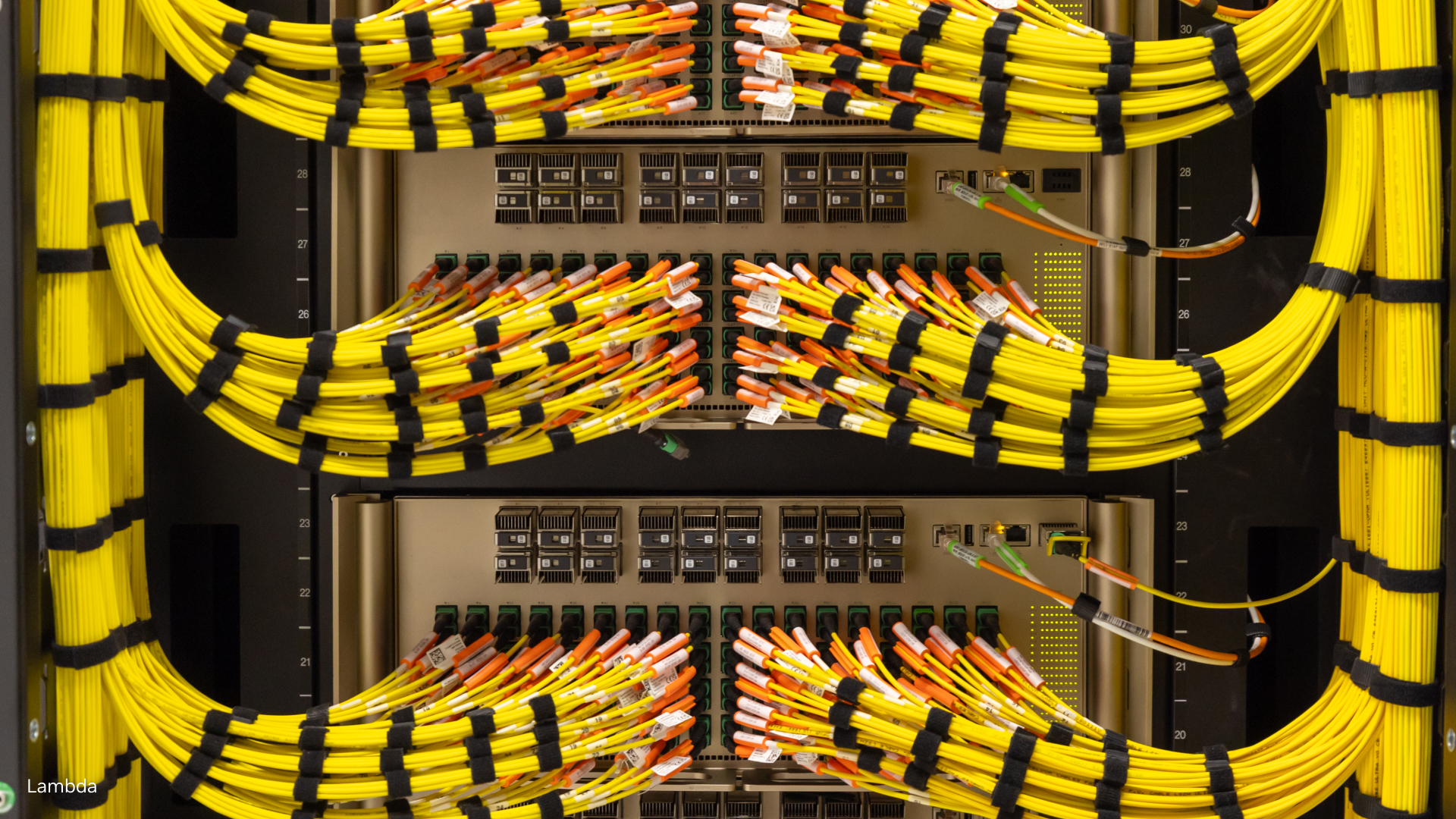
To train an AI model, thousands of GPUs must collaborate, necessitating a rapid, efficient, and resilient network. Lambda is addressing the network aspect through NVIDIA's co-packaged optics (CPO) switches. The cloud provider employs these switches to interconnect NVIDIA GB300 NVL72 racks, each housing over 10,000 GPUs, facilitating an AI factory operating at scale with enhanced power efficiency, resilience, and longer mean time between interruptions.
Dave Ward, Lambda's president of cloud services, emphasizes that "networking must keep pace with the demands of increasingly large AI clusters." In tests, network latency decreased by approximately 4% at the rack scale and up to 10% at the pod scale. Across various configurations, the network maintained the same throughput as conventional pluggable optics.
The deployment emphasizes power efficiency and resiliency, as a single interrupted link in a large training job can halt thousands of GPUs. NVIDIA Photonics addresses these challenges by replacing pluggable transceivers with co-packaged optical engines on the switch package, resulting in up to 5x better power efficiency and up to 15x higher reliability than conventional options.
With 144 ports operating at 800Gb/s and liquid cooling, Lambda's deployment achieves a median optics temperature of 36°C compared to 51°C for conventional pluggable optics, ensuring more stable signal integrity. Additionally, NVIDIA Photonics introduces replaceable external light sources, which, unlike traditional pluggable optics, require only the replacement of individual modules if a laser fails, reducing the electrical path length, eliminating retimer chips, and cutting both power consumption and the number of components in the signal path.
Written by urgent.news from NVIDIA Blog's reporting — not their text. Machine-written — may contain errors; check the original before relying on it.