NASA's Voyager 1 mission forever changed our view of Jupiter
As NASA's Voyager 1 probe reaches one light-day from Earth, we look back at its legendary photos of Jupiter that changed our view of the solar system.
On November 18, the most distant human-made spacecraft in history will reach a major milestone. Since 1977, NASA's Voyager 1 probe has been venturing deeper into our solar system, covering a distance so extensive that light takes 24 hours to travel between it and Earth. As humanity commemorates this achievement, Voyager 1 will experience a light-day in complete darkness.
Before the camera was disabled in 1990, the probe captured tens of thousands of images of our cosmic environment, many of which revolutionized our understanding of the outer planets.
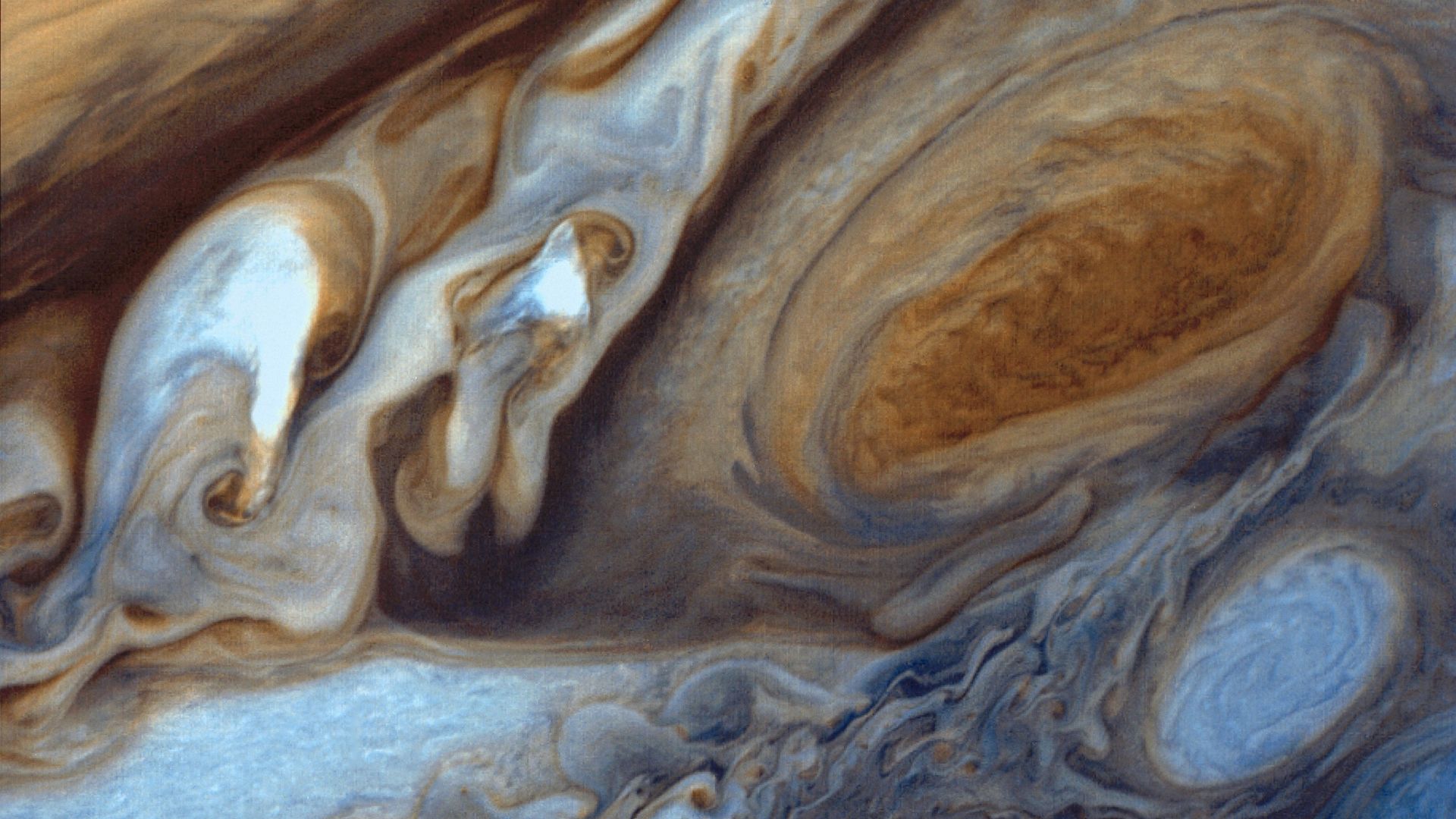
One of Voyager 1's most significant contributions was its exploration of Jupiter from January to April 1979. The spacecraft snapped a photograph of the gas giant every 96 seconds during its approach, resulting in an impressive time-lapse movie showcasing Jupiter's turbulent atmosphere. This image, taken by NASA/JPL, offers a detailed look at Jupiter, revealing bands of varying speeds and directions, swirling storms, and cloud patterns reminiscent of conveyor belts.
Over 60 full days of Jupiter's 10-hour Earth day were captured, providing the most comprehensive and high-resolution view of the planet to date.
Voyager's observations of Jupiter significantly improved upon data collected by the Pioneer 10 and 11 probes, launched a half-decade earlier. These findings demonstrated that Jupiter's atmosphere was far more dynamic than previously believed. As the probe approached the planet just before its closest approach, Voyager made a startling discovery: Jupiter boasted a thin, faint ring system.
Made primarily of dust, the rings appeared only when Jupiter was backlit by the sun. While no telescope had ever observed this before, ground-based observatories quickly confirmed the existence of the rings, and Voyager 2 captured even clearer images when it reached Jupiter in July 1979.
The discovery of Jupiter's ring system expanded our knowledge of the four outer planets—Jupiter, Saturn, Uranus, and Neptune—all of which are now known to possess rings. Scientists now suspect that Jupiter's dusty rings may be replenished partially by volcanic eruptions on Io, one of its moons. Voyager 1 witnessed the first-ever volcanic eruption beyond Earth while making a close approach to Io, observing Loki Patera, a massive volcano estimated to be 125 miles (200 km) wide. This observation revealed that moons, not just planets, can be geologically active.
These close-up views of Jupiter and its moons transformed these distant worlds from mere dots in the sky to fully realized, dynamic, and chaotic systems. Voyager 1's observations have made these celestial bodies more than just points of interest; they have become places to explore, map, and potentially visit in the future. Recent news from China's space agency announced plans for a lander mission to Jupiter's moon Callisto, marking the first-ever landing mission in the Jovian system.
As Voyager 1 continues its journey into interstellar space, it remains an invaluable source of data, studying the radiation environment using its magnetic field and plasma detectors, which are the last two of its 10 functional science instruments. Scientists predict that Voyager 1 will run out of power in the 2030s, but its discoveries about Jupiter and its moons will continue to shape our understanding of the solar system for years to come.
Written by urgent.news from Live Science's reporting — not their text. Machine-written — may contain errors; check the original before relying on it.