Why Your NumPy Array Changed After Preprocessing (Views vs Copies in ML)
Discover why NumPy arrays change during ML preprocessing. Learn how views, copies, slicing, and in-place operations affect memory and how to prevent unexpected
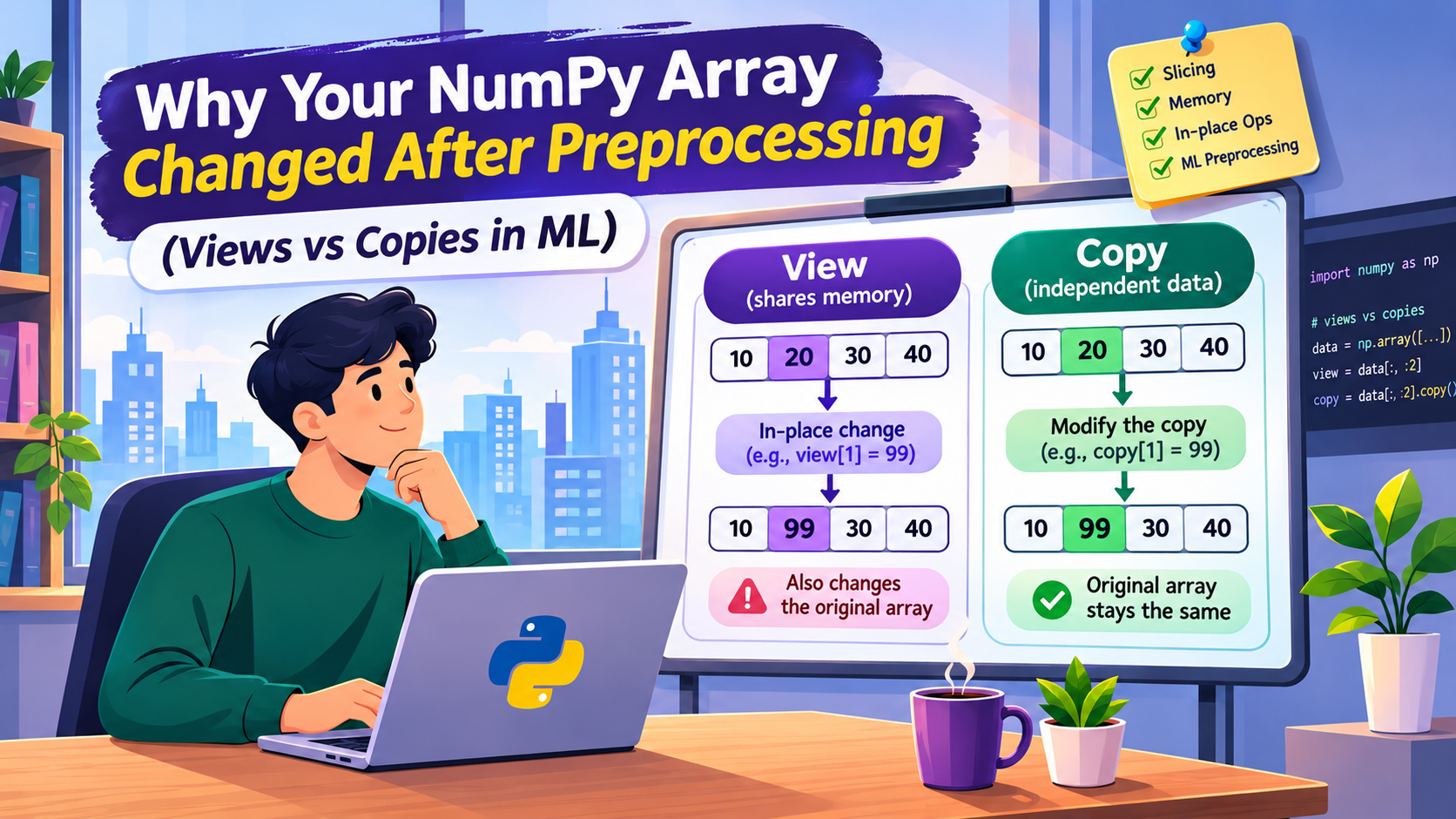
When you process data for a machine learning model, a small NumPy operation can unintentionally modify data you didn't intend to touch. Understanding views, copies, and memory sharing in NumPy can help prevent silent bugs in your pipelines.
Imagine loading a dataset, selecting a few columns, normalizing their values, and passing the result to your training algorithm. Later, when you inspect the original dataset, you notice some values have changed - even though you didn't modify it directly. This is a common issue in Python, and it happens because of the way NumPy handles memory.
When you create a new array from an existing one, NumPy doesn't always allocate new memory. Sometimes, it creates a view that points to the same underlying data. This can cause problems during preprocessing, where slicing, normalization, reshaping, and feature selection are common operations.
To avoid this issue, create an independent copy of the data before preprocessing. Instead of `features = data[:, :2]`, use `features = data[:, :2].copy()`. This way, the preprocessing will work on independent data, ensuring the original dataset remains unchanged.
You can tell if two arrays share memory using `np.shares_memory()`. For example, `np.shares_memory(original, view)` will return `True` if the original dataset and the view share memory, and `False` if they don't. Additionally, the `.base` attribute of a view shows which array owns the memory behind it, but it isn't a complete test for memory sharing.
It's important to note that not every NumPy operation creates a view. For example, basic slicing returns a view, while advanced indexing returns a copy. Advanced indexing examples include `arr[[0, 2, 4]]`, which creates a copy instead of a view.
In-place operations can also make it harder to find the problem. For instance, `features -= mean` modifies the original data directly, while `features = features - mean` creates a new array. When preprocessing code uses in-place operations on a view, it can cause changes to the original data, which can lead to unexpected results and debugging challenges.
Written by urgent.news from HackerNoon's reporting — not their text. Machine-written — may contain errors; check the original before relying on it.