These ‘Ghostly’ Galaxies Have Lost Their Dark Matter
The galaxies’ dark matter was ejected during a collision, but ironically, its absence is some of the best evidence of the elusive substance yet.
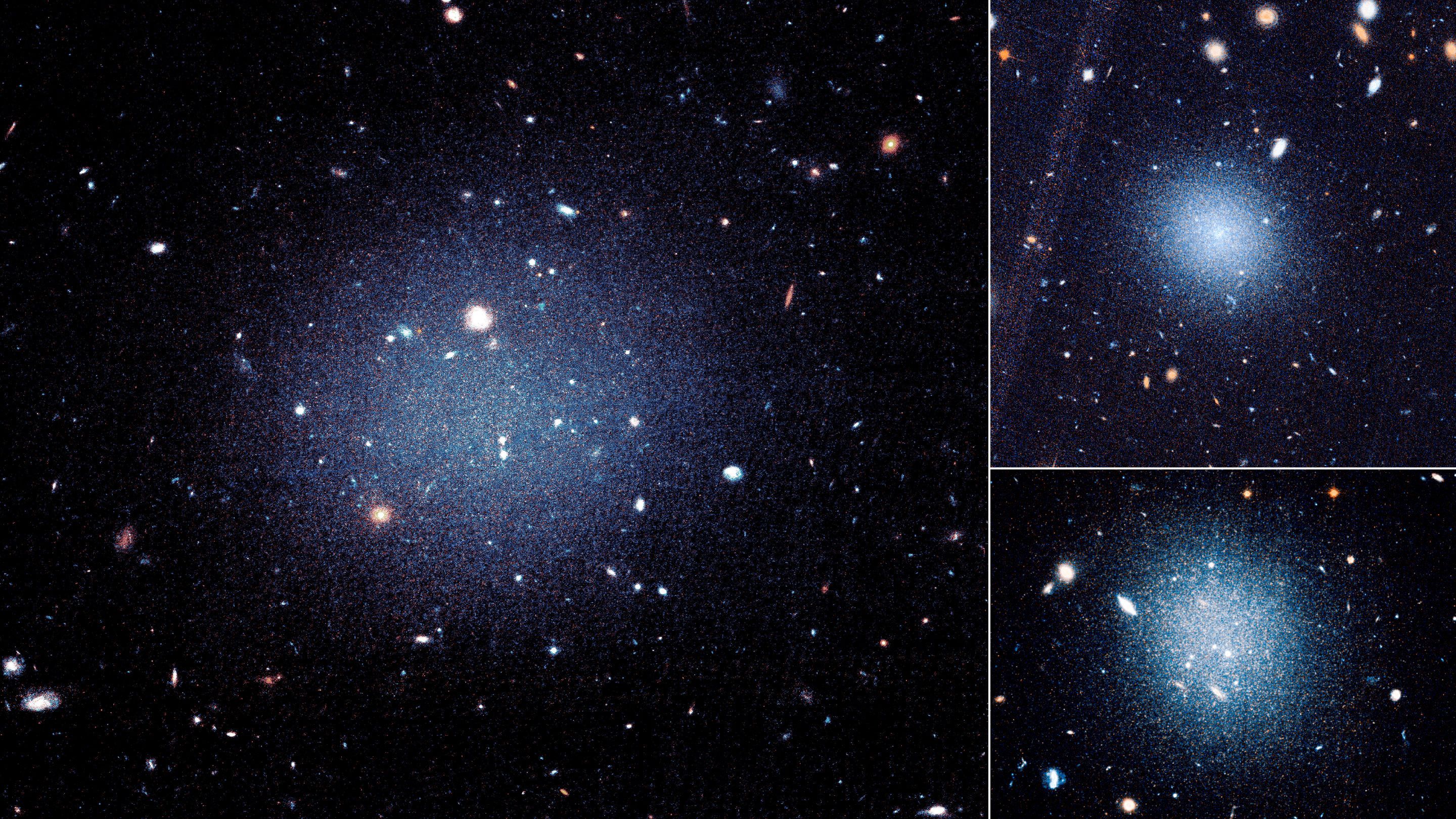
Dark matter, an invisible force that holds galaxies together, consists of 27% of the universe's matter. It keeps stars gravitationally bound within galaxies. However, three galaxies known as DF2, DF4, and DF9, have surprisingly little dark matter, making researchers question how they formed and what they tell us about dark matter itself.
These galaxies, DF2, DF4, and DF9, were first discovered in 2018, 2019, and 2026 respectively. They consist of ordinary matter, primarily gas and dust, and lack the quantity of dark matter expected in a galaxy of their size. This anomaly led astronomers to consider a potential formation scenario: two regular galaxies colliding, causing ordinary matter to clump together while dark matter passes through, leaving behind the ghostly galaxies.
The discovery of these ghostly galaxies provides strong evidence that dark matter is a physical entity, not just a modification of gravity. Dark matter's gravitational pull prevents stars on the edges of galaxies from escaping into space and enables the formation of stars by aiding in the clumping of matter. Without dark matter, the universe's largest structures would not exist.
However, while the existence of dark matter is supported by these ghostly galaxies, questions remain about its nature and composition. Dark matter may not interact with other fundamental forces, like electromagnetism. If two galaxies collided, dark matter would not experience much friction, allowing it to pass through, while ordinary matter would get tangled up.
In conclusion, the discovery of DF2, DF4, and DF9 provides compelling evidence for the existence of dark matter and its crucial role in shaping the universe. However, the nature of dark matter remains a mystery, and further research is needed to understand its properties and interactions fully.
Written by urgent.news from Wired's reporting — not their text. Machine-written — may contain errors; check the original before relying on it.
This story
This is one outlet's version. Read the fullest account.