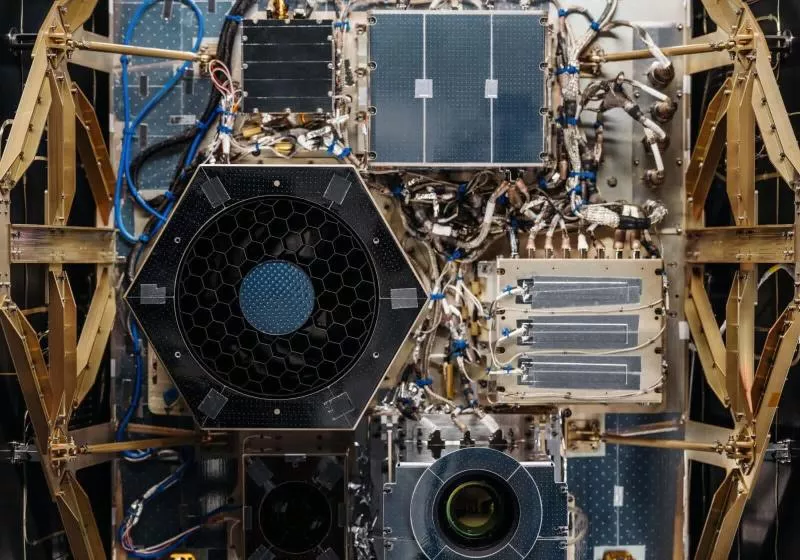
Euclid's first data release: A stepping stone to its 3D map of the sky
The ESA's Euclid has already teased us with some early results. In the past, it's given us a small image covering 60 square degrees of the sky, created with a few days of observations. Those images showed individual targets from the Horsehead Nebula to the Perseus cluster of galaxies.

The European Space Agency's Euclid space telescope has released its first major data set, a foundation catalog named DR1-Foundation, which covers an area of the sky comparable to about 9,500 full moons and contains information about over 1 billion celestial objects. This data release is part of Euclid's Wide and Deep Surveys, two projects that will collectively create a 3D map of the universe, vital for studying dark energy and dark matter.
With its space-based location and advanced optics, Euclid will produce a more detailed and voluminous map than previous ground-based efforts like DESI, the Dark Energy Spectroscopic Instrument. The Wide Survey, Euclid's primary mission, will image and observe faint objects in visible and near-infrared light, covering about 1,900 square degrees of the sky. This will represent approximately 14% of the total sky Euclid will observe during its six-year mission.
The Deep Survey, on the other hand, will focus on detecting fainter, more distant objects such as dwarf galaxies, low-mass galaxies, tidal tails, high-redshift galaxies, and quasars. This survey will not only aid in calibrating the Wide Survey but also provide its own unique scientific insights through a higher density of sources.
One of the standout images from the data release is the ring galaxy NGC 1291, also known as the Golden Eye galaxy, which features both an inner and outer ring, possibly resulting from a merger with a gas-rich galaxy. Euclid also captured images of the massive galaxy cluster Abell 3128, which plays a crucial role in studying dark matter and dark energy due to its gravitational lensing effects.
Written by urgent.news from Phys.org's reporting — not their text. Machine-written — may contain errors; check the original before relying on it.
This story
This is one outlet's version. Read the fullest account.
- Euclid's First Data Release: A Stepping Stone to its 3D Map of the Sky universetoday.com