Euclid's First Data Release: A Stepping Stone to its 3D Map of the Sky
The ESA's Euclid Space Telescope has released its first huge batch of data. It's all part of the telescope's mission to study dark energy and dark matter. The telescope is busy creating the largest ever 3D map of the Universe with its huge 600 megapixel camera, and new images give us some highlights.
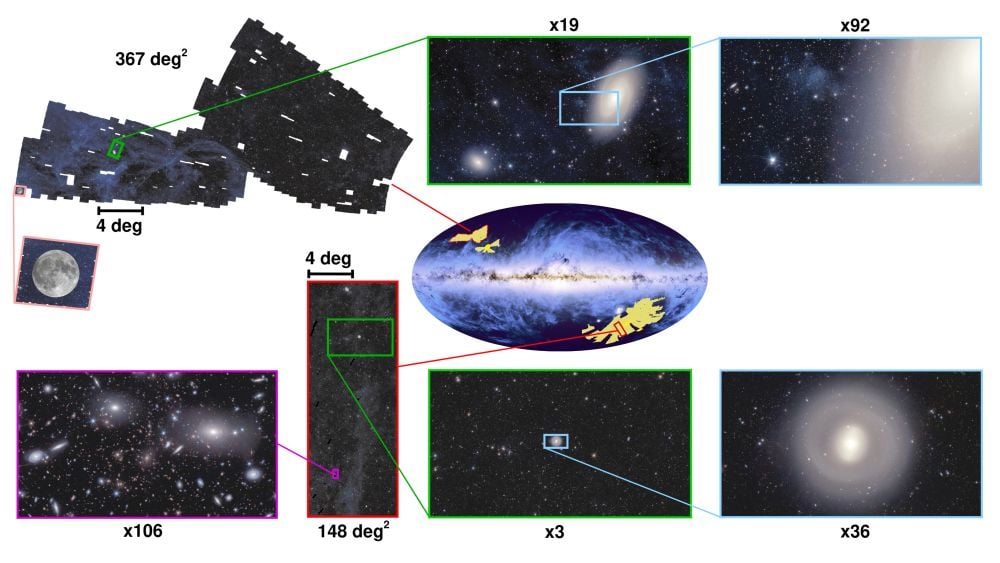
The European Space Agency's Euclid space telescope has just released its first data set, dubbed DR1-Foundation, which covers an area of sky approximately nine thousand times larger than the full moon and collects light from over a billion celestial objects. This data set is a crucial stepping stone towards Euclid's ultimate goal of creating a comprehensive three-dimensional map of the cosmos, a project that will span six years.
Compared to DESI, which has already created the largest 3D map to date, Euclid is set to exceed it in both scale and detail due to its space-based location, which allows it to avoid atmospheric interference and achieve higher resolution. The data released thus far is from two of Euclid's major surveys: the Wide and Deep Surveys, which together will form the backbone of its 3D map.
While the data currently released only represents around 14% of the total sky Euclid will cover during its mission, it already showcases Euclid's impressive capabilities. Images released include the core of the Messier 81 galaxy group, the ring galaxy NGC 1291, and the Abell 3128 cluster, a massive collection of hundreds of galaxies. Euclid's images reveal intricate details such as galactic cirrus clouds, bars, and gravitational lenses.
Beyond visual appeal, these images are scientifically valuable. Abell 3128, for example, is crucial for studying dark energy and dark matter. As part of a larger supercluster, it serves as an excellent probe for these elusive components of the universe. The release of this first data set also reveals that Euclid is already making discoveries, including the discovery of a new comet, the most ancient quasar in the Universe, and a closer look at the Milky Way's center.
Written by urgent.news from Universe Today's reporting — not their text. Machine-written — may contain errors; check the original before relying on it.