Breakthrough cosmic hydrogen measurement could transform our view of the Universe
The MeerKLASS international collaboration achieves the first direct measurement of the large-scale clustering of cosmic hydrogen in the Universe.
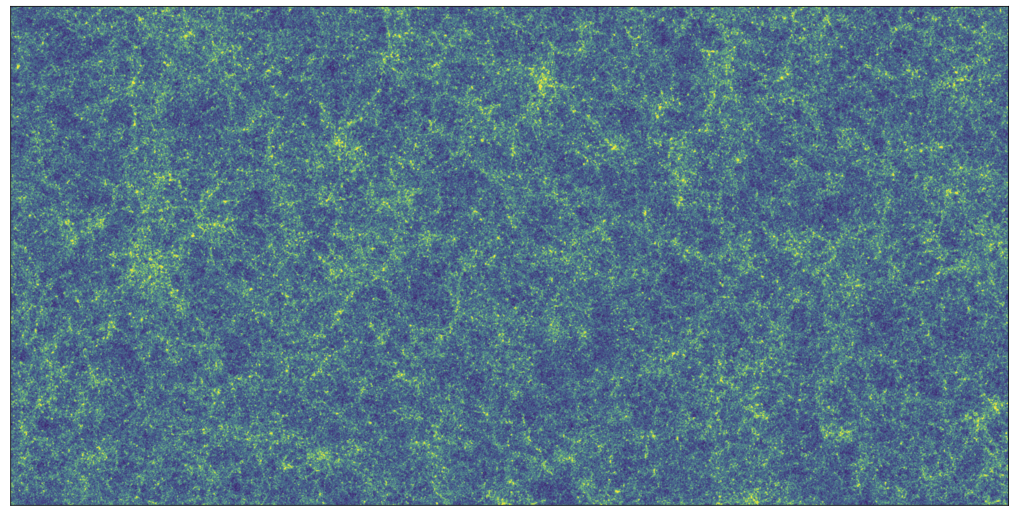
The MeerKLASS Collaboration of international astronomers has made a groundbreaking measurement of cosmic hydrogen, which could revolutionize our understanding of the Universe. Over the past decade, scientists have been mapping the large-scale structure of the cosmos to determine if it matches observations of the cosmic web. Neutral hydrogen, the most abundant element in the Universe, was present during the Cosmic Dark Ages and remains abundant today in the interstellar medium (ISM) and intergalactic medium (IGM).
The MeerKLASS Collaboration employed a technique called HI intensity (or 21-cm intensity) mapping to detect cosmic hydrogen using the MeerKAT radio telescope. This involved extracting the 21-cm signal from the overwhelming background noise, which is about 10,000 times stronger than the hydrogen signal itself. To achieve this, the team operated each dish independently, rather than combining them into a single interferometer, a novel observation mode for MeerKAT that prioritized high survey speed over sharp angular resolution.
After analyzing data from ~250 square degrees of sky, the team detected a neutral hydrogen signal from 4.5 billion years ago, or 9 billion years after the Big Bang. By comparing multiple independent maps from different dishes and observing times, the researchers were able to suppress instrument effects and highlight the cosmic hydrogen's structure.
This achievement, led by Dr. Steven Cunnington, marks a significant milestone in establishing 21-cm intensity mapping as a powerful tool for cosmology. The measurement can help constrain critical cosmological measurements, such as the expansion rate of the cosmos, the influence of Dark Energy, and the distribution of Dark Matter.
Professor Mário Santos of the University of the Western Cape hailed this accomplishment as a testament to the power of teamwork and collaboration across seven countries and three continents.
Written by urgent.news from Universe Today's reporting — not their text. Machine-written — may contain errors; check the original before relying on it.