Apple's Claris Testing 'Harbor' App for Local AI on Macs
Apple's Claris subsidiary is testing an app called Harbor , which turns Apple silicon Macs into a private AI server. Harbor works with a single Apple silicon Mac, but it also supports connecting multiple Mac computers over Thunderbolt 5 to pool unified memory for larger models. Apple added RDMA over Thunderbolt 5 with macOS Tahoe 26.2, making clustering faster. Harbor detects devices connected…
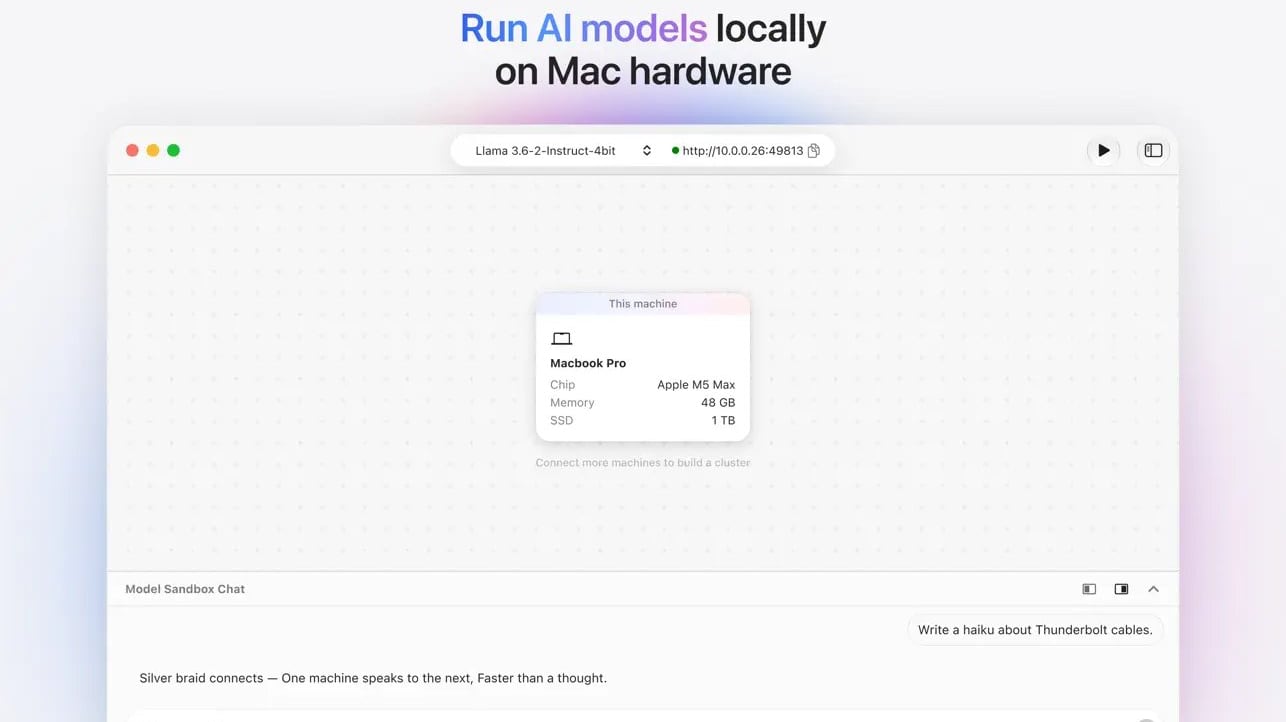
Apple's Claris division is currently evaluating a new application named Harbor, designed to transform Apple silicon Macs into private AI servers. This innovative app allows for the utilization of a single Mac computer, as well as the connection of multiple Macs via Thunderbolt 5 to form a cluster and share memory for handling larger models. Apple recently incorporated Remote Direct Memory Access (RDMA) over Thunderbolt 5 into macOS Tahoe 26.2, which enhances the speed of clustering.
Harbor automatically identifies devices linked through Thunderbolt 5, enabling users to search for, download, and load open-weight models with ease. It is positioned as a user-friendly application that does not require any manual configuration. The app essentially converts the Mac into a private AI inference server, allowing users to run open-weight models locally on Apple silicon, ensuring that data remains on their hardware and never reaches the cloud.
By connecting multiple Mac computers through Thunderbolt 5, Harbor enables users to pool their unified memory, thereby supporting larger models and higher concurrency than would be possible with a single computer. Users can set up the system in a matter of minutes, rather than hours. Once connected, the app automatically detects devices over Thunderbolt 5 to create a cluster.
Harbor does not necessitate any manual setup, command line inputs, or existing infrastructure knowledge. Users can simply plug in their devices, start the app, and begin running models directly. Additionally, the app manages model management, allowing users to concentrate on their work rather than the setup process. The application also offers the ability to cluster for scalability.
Connecting two or more Thunderbolt 5-capable Mac computers allows Harbor to combine their unified memory into a single inference resource, thereby running models that surpass the capacity of any single computer, or serving more concurrent requests across the cluster.
Harbor is currently in the early access phase and not publicly available, as it is listed on the App Store but has since been removed. Claris, known for its database platform FileMaker targeted at businesses, is an enigmatic entity regarding the marketing strategy and pricing of the Harbor app. The sign-up page for Harbor requests a company name, hinting at a more business-oriented focus.
Although there are existing, free alternatives such as the open-source tool Exo for clustering Macs, and LM Studio for single-Mac use, Apple's Harbor app appears to amalgamate the simplicity of LM Studio with the clustering capabilities of Exo. This development was initially reported on MacRumors.com.
Written by urgent.news from MacRumors's reporting — not their text. Machine-written — may contain errors; check the original before relying on it.