Running Kubernetes at Its Extremes
Kubernetes supports up to 5,000 nodes per cluster, and SIG Scalability’s performance targets only apply inside that limit. I look at what breaks in etcd, the API server and node traffic past it, and what a control plane needs on hardware small enough to fit in a hand. The post Running Kubernetes at Its Extremes appeared first on Cloud Native Now .
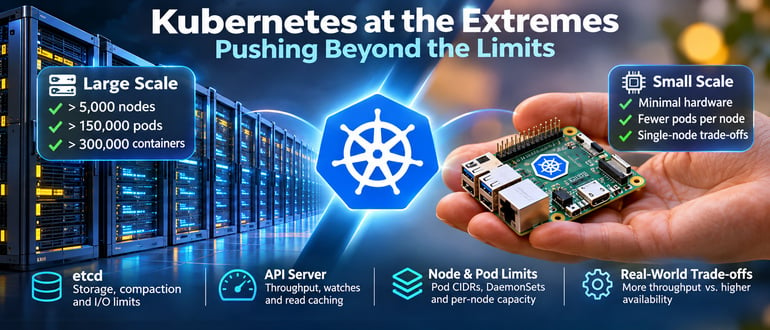
Kubernetes has caps on the number of nodes and pods it can support. Pushing beyond these limits, such as running 5,000 nodes or a single tiny device, uncovers bottlenecks in networking, API performance, and storage. The project maintains clear thresholds for API responsiveness and availability, but real-world demands often surpass these limits.
At KubeCon + CloudNativeCon North America 2026, two demo clusters will be showcased: one scaled beyond recommended limits to identify weaknesses and another miniaturized to demonstrate downsized requirements. The project's documentation sets 5,000 nodes, 110 pods per node, 150,000 pods, and 300,000 containers as its supported scale.
ETCD, which stores all cluster state, faces storage limits of 2 GB by default. As the cluster expands, etcd's capacity becomes strained, leading to storage alarms and read-only operations until space is freed. The API server handles the majority of the load, and read caches and gRPC optimizations help, but scaling the API remains a constant challenge.
Each node renewal sends status updates every 10 seconds, adding to the load at scale. The project's scalability continues to evolve with each release, with a focus on throughput optimization to meet budget and availability requirements. When scaling, various factors must be considered, such as hardware constraints, network traffic, and storage capabilities.
Pushing both extremes reveals the underlying assumptions about hardware and scale that Kubernetes defaults make.
Written by urgent.news from Container Journal's reporting — not their text. Machine-written — may contain errors; check the original before relying on it.