Mars' Molten Heart is Long Gone, but Some Magma Chambers May Persist
Mars may be more volcanically active than we thought, according to new research. The Trace Gas Orbiter detected HCl, a chemical associated with magma, at a time of year that's difficult except by volcanic origins. The new research also identified new surface fissures on Mars that could be the source of the chemical.
The allure of Mars never wanes, often likened to a less successful Earth. Billions of years ago, this planet was warm, wet, and potentially habitable. However, its geological engine cooled, its protective magnetic field disappeared, and the Sun's harsh rays stripped away its atmosphere. Mars' past was marked by significant volcanic activity, evident in towering volcanoes like Olympus Mons.
Yet, it is thought to have left behind its volcanic past due to cooling. Recent discoveries, though, suggest Mars might not be entirely dormant.
Probes like InSight and the ExoMars Trace Gas Orbiter have detected more than 1300 Marsquakes and traces of hydrochloric acid (HCl) in the Martian atmosphere, albeit seasonally. The ExoMars Trace Gas Orbiter (TGO) observed HCl at parts-per-billion levels, predominantly during perihelion. Initially, these detections were attributed to seasonal warming and atmospheric interactions driven by the Sun. However, new research in Science Advances proposes that not all HCl detections can be explained by this seasonal pattern.
The publication, titled "Enigmatic HCl detections as a potential signature of igneous activity on Mars," was authored by Alexander Trokhimovskiy from the Space Research Institute at the Russian Academy of Sciences. The researchers acknowledge that Mars is considered volcanically dormant, but there is growing evidence of recent volcanic activity.
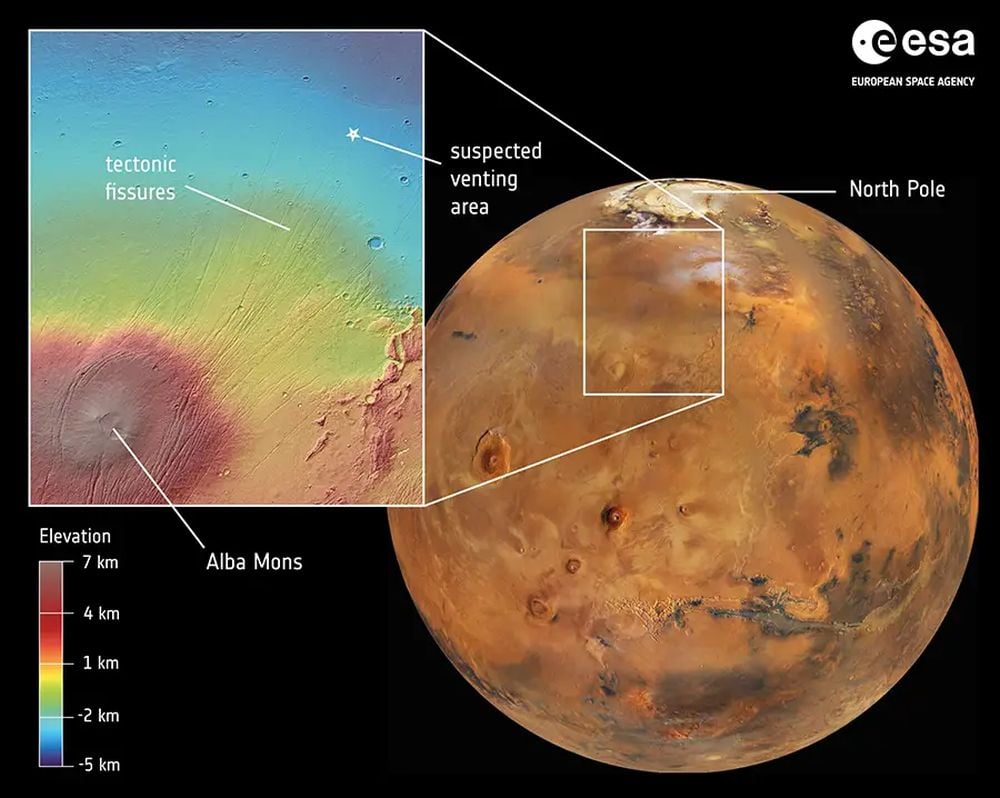
The authors focus on HCl detections during the cold aphelion season, which are nearer to Alba Mons, a volcano with a surface area larger than Olympus Mons. The HCl detections in this region are both localized and time-specific, raising intriguing questions about potential magma chambers beneath the surface.
The researchers assert that the aphelion HCl detections, which can't be explained by seasonal warming and atmospheric interactions, hint at an igneous origin of this gas. Fresh and narrow fissures (1 meter wide) identified in this area suggest potential pathways for HCl seepage from magmatic bodies at depth. These findings, while not definitive, offer compelling evidence that might provide a new understanding of Mars' interior.
Written by urgent.news from Universe Today's reporting — not their text. Machine-written — may contain errors; check the original before relying on it.