Korea Advances Physical AI Across Industries With NVIDIA
Tapping into the country’s strengths in manufacturing and engineering, NVIDIA is helping advance Korea’s physical AI ecosystem. The country’s industry leaders are applying accelerated computing, AI and simulation to everything from semiconductor manufacturing to robotics and autonomous vehicles. These efforts are helping bring physical AI from development into real-world production. Samsung…
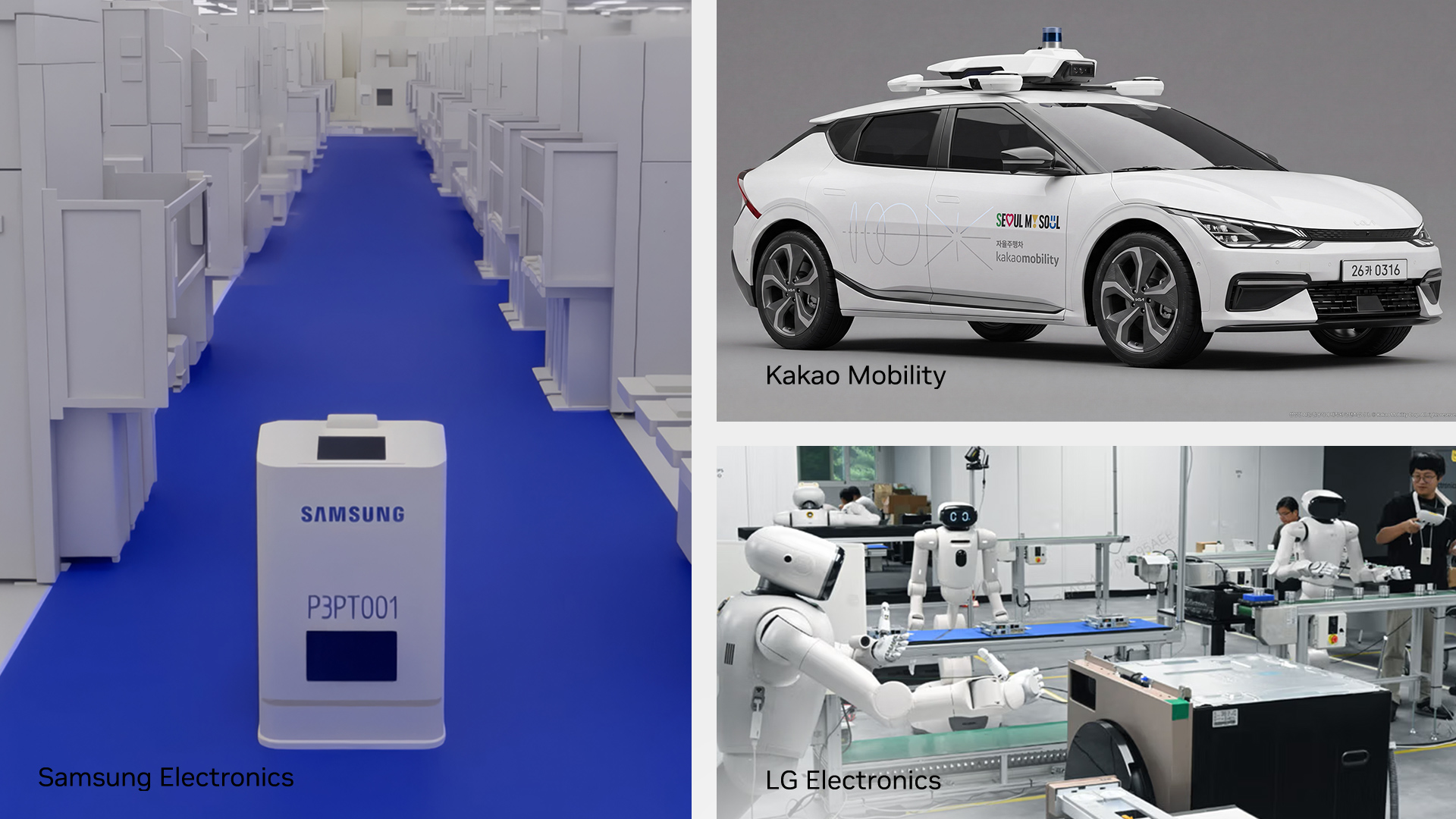
Korea is advancing its physical AI ecosystem through collaborations with NVIDIA, leveraging accelerated computing, AI, and simulation across various industries. Samsung Electronics is expanding its partnership with NVIDIA to accelerate semiconductor innovation, utilizing AI physics for materials research, process development, and device engineering.
Samsung's sMOL platform has achieved a 5x speedup in quantum chemical calculations with NVIDIA cuEST. The company is also exploring NVIDIA cuEquivariance for tensor operations in atomistic AI models. In semiconductor engineering, Samsung is developing chip-scale thermal and mechanical analysis workflows with NVIDIA PhysicsNeMo. Simulation time for design optimization has been drastically reduced, from 18 hours to 41 seconds, through GPU acceleration.
Kakao Mobility is partnering with NVIDIA to develop a level 4 autonomous driving system, incorporating Kakao Mobility's proprietary driving software and NVIDIA's vehicle computing platform. The collaboration will utilize NVIDIA Hyperion and Halos for vehicle sensors, compute, and safety, with initial development focused on Kia purpose-built vehicles.
LG Electronics has demonstrated NVIDIA Isaac GR00T-powered robotic manipulation and manufacturing tasks using LG's CLOiD robot in a real manufacturing environment. The collaboration has implemented a physical AI data flywheel, connecting real-world data collection, data augmentation, model training, onboard computing, and simulation-based evaluation. This process aims to refine a repeatable workflow for continued development and validation of CLOiD's robotic capabilities in manufacturing.
Written by urgent.news from NVIDIA Blog's reporting — not their text. Machine-written — may contain errors; check the original before relying on it.