Interest Sensitive and Insensitive Investment and the Two Speed Economy
Aggregate nonresidential investment has surged despite elevated interest rates. The aggregate conceals the mixed. Figure 1: Ten year Treasurys, % (black,left scale), nonresidential fixed investment, bn.Ch.2017$ SAAR (red, right log scale). Source: Treasury, BEA. Components related to the AI boom have continued to grow relatively unabated: Figure 2: Ten year Treasurys, % (black,left scale),…
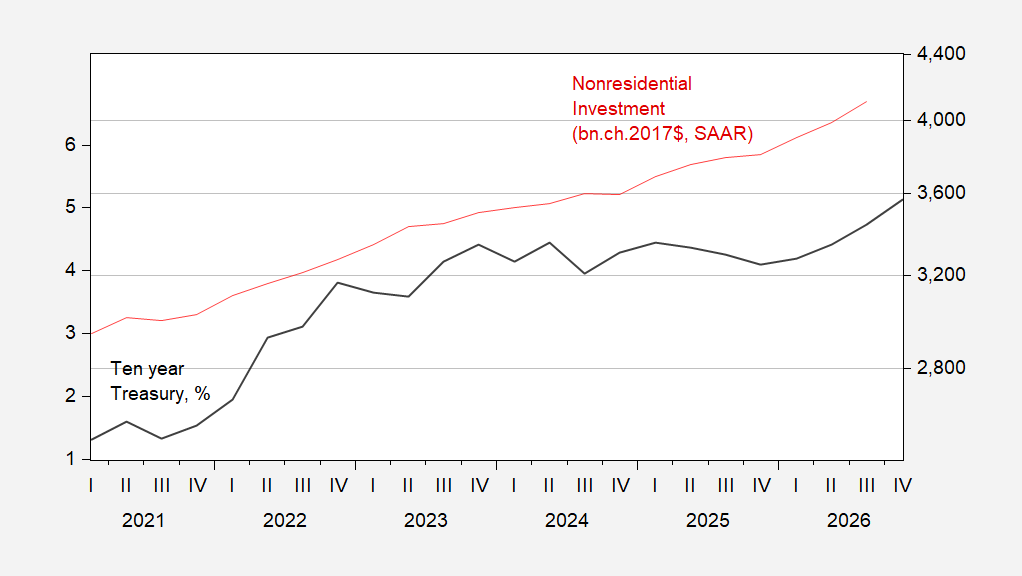
Aggregate nonresidential investment has been on the rise despite higher interest rates, as shown in the data (Source: Treasury, BEA). However, this aggregate figure masks the complexities within it. Figure 1 illustrates this, with the ten year Treasurys percentage on the left scale and nonresidential fixed investment in billions of chained 2017 dollars, seasonally adjusted annual rate (SAAR) on the right scale (Source: Treasury, BEA).
Notably, components linked to the artificial intelligence (AI) boom have continued to expand without significant hindrance, as depicted in Figure 2. The left scale displays the ten year Treasurys percentage, while the right scale shows two specific investments: information equipment and software, and information equipment, software, data center, and electric power structures investments, all in billions of chained 2017 dollars, SAAR (Source: Treasury, BEA).
Interestingly, the growth of information equipment and software investment remains robust through the third quarter of 2026. Figure 3 further breaks down this trend, displaying nonresidential investment excluding information equipment and software, alongside nonresidential investment excluding information equipment, software, data center, and electric power structures, both in billions of chained 2017 dollars, SAAR (Source: Treasury, BEA).
In contrast, investment that does not include AI-related components is currently lower than its recent peak. This phenomenon of "two-speed" capital expenditure (capex) behavior is evident in the total returns of the Bloomberg Mag-7 index compared to the overall SP500 index, which has become heavily weighted towards AI-related stocks recently (Source: Bloomberg, accessed 11/9/2026).
Recent discussions suggest that as major players in the industry increasingly tap into debt markets for funding their capex, the sensitivity to interest rates for AI-related capex investments may intensify, potentially dramatically. If this analysis holds true, monetary policy, particularly through higher interest rates, may exert a more substantial influence on economic output in the future.
Written by urgent.news from Econbrowser's reporting — not their text. Machine-written — may contain errors; check the original before relying on it.