Greentech-Serie: Zukunft in 365 Meter Höhe: Sind Höhenwindtürme der Turbo für die Energiewende?
In Schipkau in der Lausitz steht das höchste Windrad der Welt. Schon ist der erste Park mit mehreren Rekordanlagen in Planung. Dabei steht die Technologie noch am Anfang.
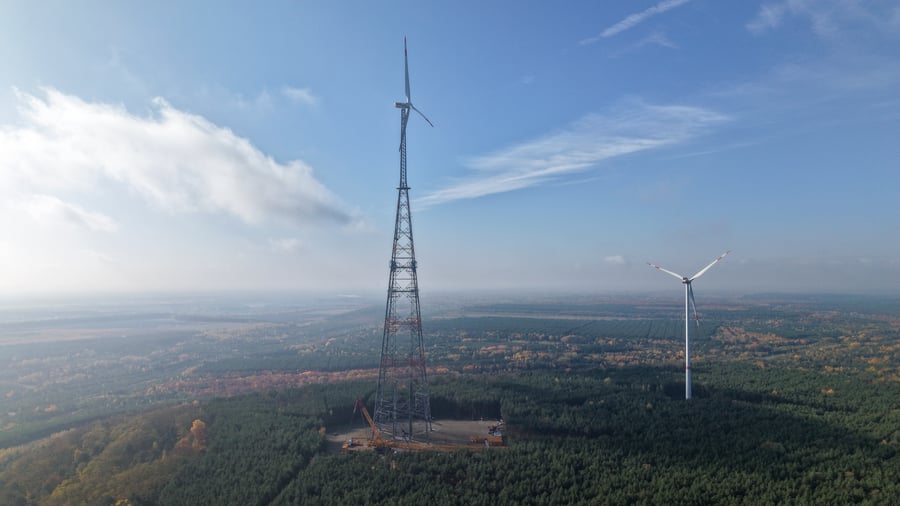
In the quiet town of Schipkau, nestled between Dresden and Berlin, a colossal 365-meter-high wind turbine has recently sprouted amidst an old lignite mine. This towering colossus dwarfs the Eiffel Tower in Paris, standing 150 to 200 meters tall on its own. The surrounding wind turbines look almost quaint in comparison.
Construction of this record-breaking wind turbine is nearing completion, and it is soon to be connected to the power grid. For weeks, visitors from Germany and abroad have flocked to the eastern German town to witness this groundbreaking achievement. Expectations are high, as Jochen Großmann, engineer and CEO of Gicon – the company behind the turbine – claims the Höhenwindturm can generate twice the energy of a standard onshore turbine, despite having the same rotor diameter.
With over 2000 tons of steel and 22,000 individual parts, Großmann proudly declares this an engineering feat. If predictions hold true, this high-altitude wind power could significantly boost the Energiewende, or Germany's energy transition. Compared to traditional wind turbines, high-altitude wind power offers several benefits.
Wind farms in greater heights capture more and more predictable wind energy. For years, scientists and companies worldwide have been striving to harness larger heights for energy generation, such as airborne wind energy systems or mobile flying wind turbines.
However, the breakthrough has so far eluded them. While airborne wind energy systems capture a large surface area in the air and only yield a relatively small return in current pilot projects, high-altitude wind power promises to double the output of conventional land-based turbines while still standing firmly on the ground. The Federal Agency for Innovation (Sprind) estimates a potential of around 4000 high-altitude wind turbines in existing wind farms across Germany. Sprind has already provided 25 million euros in funding for the Schipkau project.
To reach a height of 365 meters, the Dresden team developed a unique telescop system. The turbine sits atop the inner tower, and after the outer scaffold is completed, the inner steel structure is hoisted using a hydraulic lifting system attached to the outer scaffold. Traditional cranes for such heights do not exist, making the Höhenwindturbine its own crane.
The turbine's nominal power output of 3.8 megawatts is expected to generate electricity for up to 7,500 households. Future models, however, may be equipped with the latest turbine generation, boasting a seven-megawatt capacity, according to Gicon. The Sprind innovation manager, Martin Chaumet, predicts that such technology will become widely available in the coming years, contributing significantly to Germany's energy security.
Großmann also announces that Gicon plans to build five more high-altitude wind turbines, with series production starting by 2030. Already, there are letters of intent for the construction of 100 additional high-altitude turbines across Germany.
While the Versorger Enercity, which oversees technical and commercial operations at the Höhenwindturm in Schipkau, acknowledges the technology's potential, they caution that the final success of the project hinges on the extent of the yield increase and the ability to lower costs. Current costs for Höhenwindturbines are roughly four times higher than those of a "normal" wind turbine.
Großmann asserts that if the anticipated yield increase is taken into account at 300 meters in this location, the cost per kilowatt hour should drop by about 60% to match today's onshore turbine costs.
Gicon anticipates significant cost reductions through mass production, especially in the steel required for the tower. They aim to achieve even lower construction costs than today's onshore prices by 2030. However, high-altitude wind power faces another hurdle: the impact on public acceptance, particularly in visually appealing landscapes. Ötjen, deputy head of operations at Enercity Erneuerbare, stresses the importance of analyzing how these taller wind turbines with their unique design may affect public perception. The acceptance of wind power remains an ongoing challenge.
Written by urgent.news from Handelsblatt's reporting — not their text. Machine-written — may contain errors; check the original before relying on it.