Are the James Webb Space Telescope's mysterious Little Red Dots actually tiny black holes left over from the Big Bang era?
New research suggests that Little Red Dots, which have puzzled astronomers since the JWST began discovering them, could host primordial black holes born during the Big Bang.
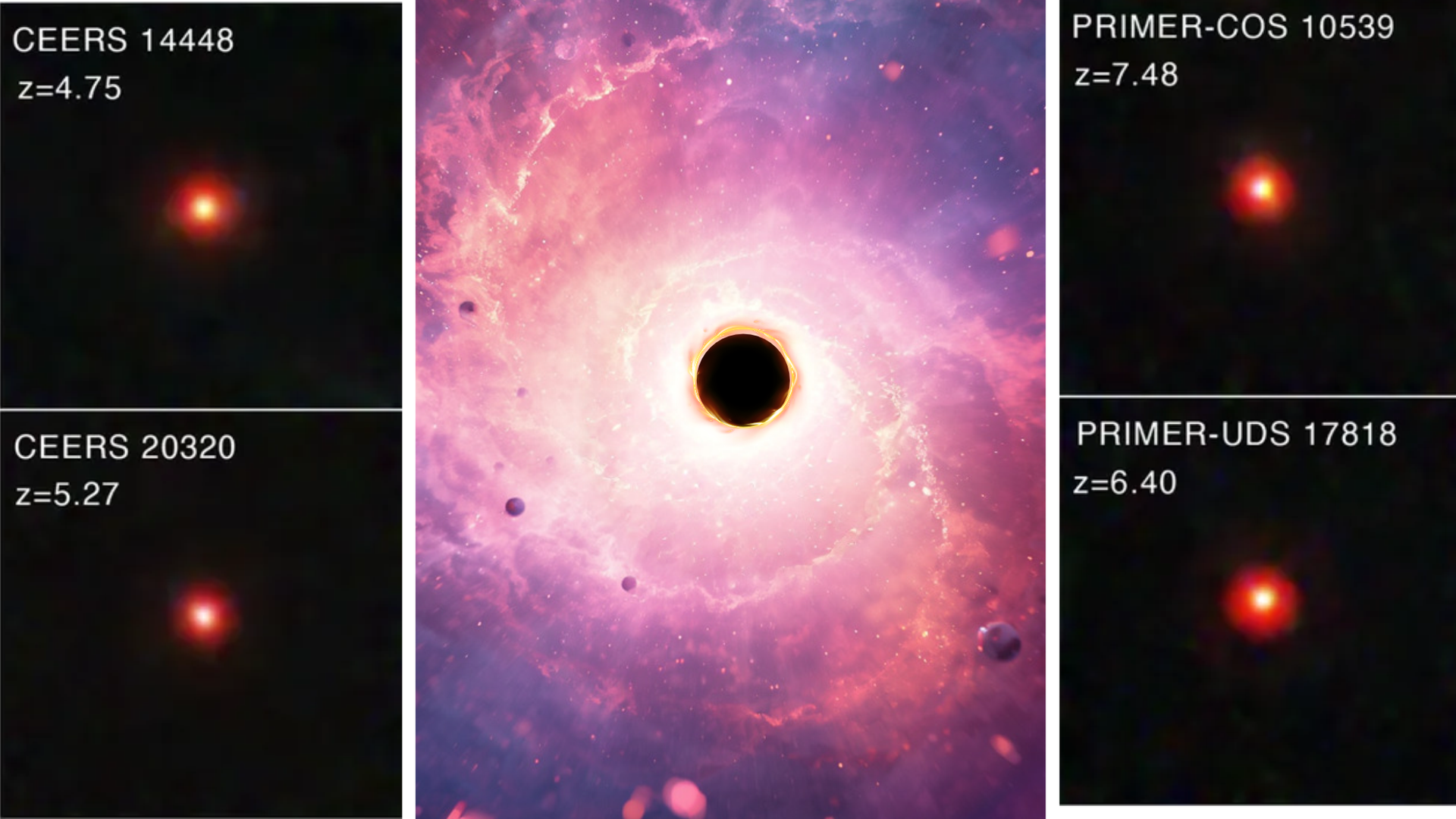
Since NASA's James Webb Space Telescope (JWST) began peering into the early cosmos, it has unveiled numerous surprises. Among these are the "Little Red Dots," cosmic objects that seemingly vanish before the universe reaches two billion years old. Fresh research proposes that these dots may actually be primordial black holes, which are formed from density fluctuations in the early universe, right after the Big Bang. These hypothetical black holes would predate stars, dust, and heavier elements.
Valerio De Luca, a researcher from Johns Hopkins University, explained that primordial black holes are formed from the physics of the early universe, distinct from traditional black holes born from massive star deaths. While scientists have theorized about primordial black holes since their proposal by Stephen Hawking in the 1970s, there's no direct evidence of their existence.
The key challenge lies in differentiating primordial black holes from traditional black holes, formed from supernova explosions of massive stars. Little Red Dots might potentially encircle traditional black holes, or they could be primordial black holes if they exist. To determine which scenario is accurate, De Luca and colleagues focused on QSO1, a Little Red Dot observed just 700 million years after the Big Bang.
QSO1 stands out because it is almost entirely composed of hydrogen and helium, the earliest elements in the universe, potentially providing a more pristine sample for study. The researchers modeled how QSO1 might have formed from a primordial black hole, considering three possible scenarios. The most plausible scenario involves a smaller primordial black hole absorbing surrounding gas and energy until it reached QSO1's size.
The team suggests that this scenario is more likely than others, hinting at the possibility that Little Red Dots could be primordial black holes.
The researchers plan to examine the remaining 100 or so Little Red Dots detected by the JWST to ascertain how many might have originated as primordial black holes. This could provide the much-needed evidence to confirm the existence of these ancient black holes, offering groundbreaking insights into the early universe's conditions and the formation of these mysterious cosmic objects.
Written by urgent.news from Space.com's reporting — not their text. Machine-written — may contain errors; check the original before relying on it.