Backward world? Rubin finds a retrograde object past Neptune
The Rubin Observatory in Chile has discovered a retrograde object in our solar system. It circles the sun in a highly inclined orbit beyond Neptune. The post Backward world? Rubin finds a retrograde object past Neptune first appeared on EarthSky .
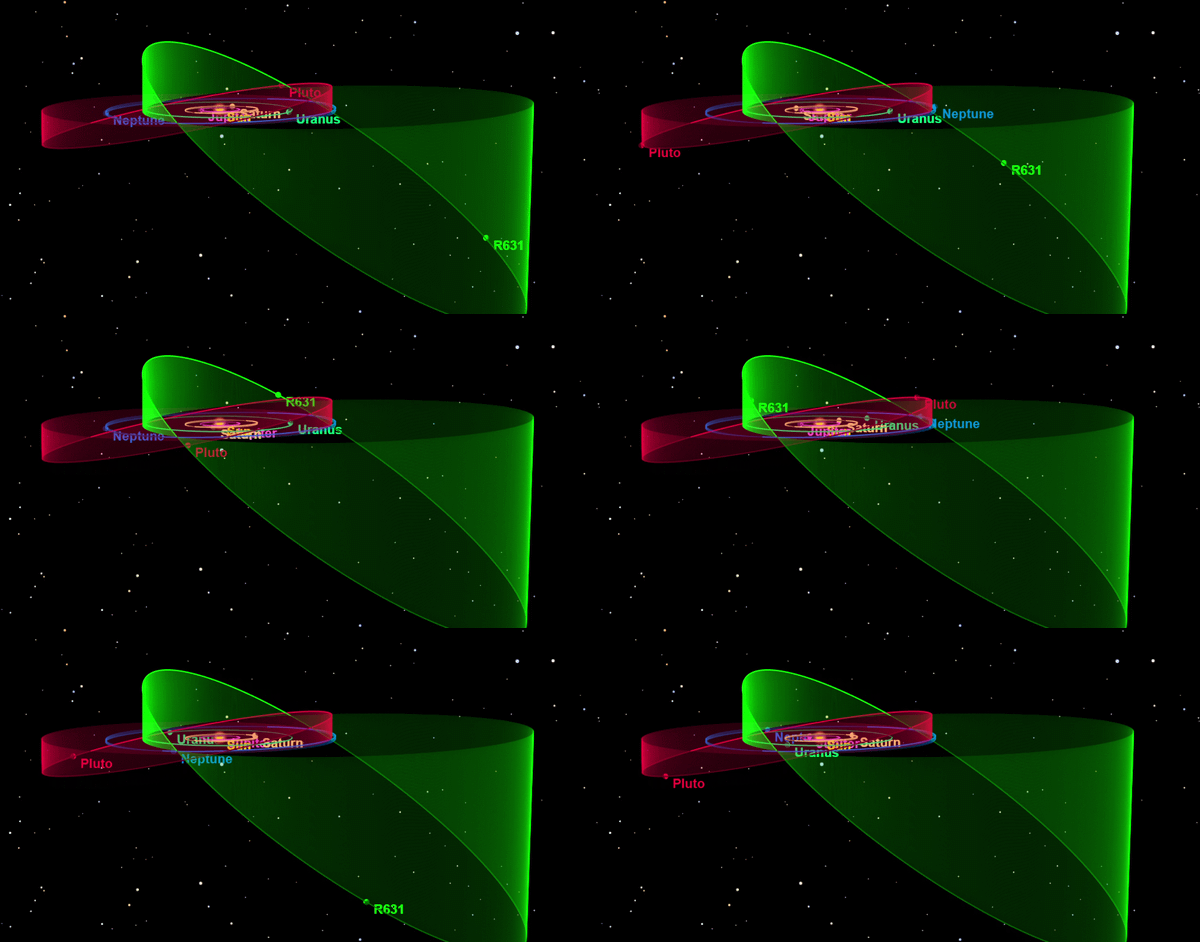
The Rubin Observatory, located in Chile, has recently discovered a retrograde object named R631. This object orbits the sun beyond Neptune, at a steep inclination. Most planets, moons, and asteroids in our solar system orbit the sun in a relatively flat plane, generally moving in the same direction, counterclockwise when viewed from the Earth's north.
However, R631 is an exception, with its orbit tilted 142 degrees relative to this plane, slicing through at a severe angle. This classification of an object moving in a direction opposite to the majority as retrograde is more precise in astronomy.
The designation R631 is currently temporary and will soon be replaced by an official designation from the Minor Planet Center. Astronomers and citizens monitoring the Rubin Observatory's data noticed this object over a period of four months. R631 was observed by Rubin's instruments between December 2025 and March 2026. It is located 32 astronomical units (AU) from the sun, which is 30 times the distance between the Earth and the sun, placing it just beyond Neptune's orbit.
R631 will reach its closest point to the sun, known as perihelion, on October 31, 2047, at a distance of 24 AU. If its orbit is accurate, it will take R631 approximately 547.84 Earth-years to complete one full orbit of the sun. Physicist and astronomer Marshall Eubanks estimated that R631 could be 62 miles (100 km) in diameter, potentially resembling the largest known Oort cloud comet, Comet Bernardinelli–Bernstein.
One theory suggests that R631 might have originated from another solar system, been flung out of its system and pulled into the sun's gravity well. Alternatively, it could have begun life in our solar system with a prograde orbit, similar to Earth's, and then encountered a large object like Jupiter or a passing star, causing it to be ejected into a retrograde path. The object is likely to be from the Kuiper belt and may become active around its 2047 perihelion, similar to Comet Bernardinelli–Bernstein.
Written by urgent.news from EarthSky's reporting — not their text. Machine-written — may contain errors; check the original before relying on it.