Solar above, fish below: Double-decker farms could rival US power use
Floating solar panels over the world’s fish and shrimp ponds could generate 4,100 terawatt-hours of electricity, avoiding up to 2.5 billion tons of emissions.
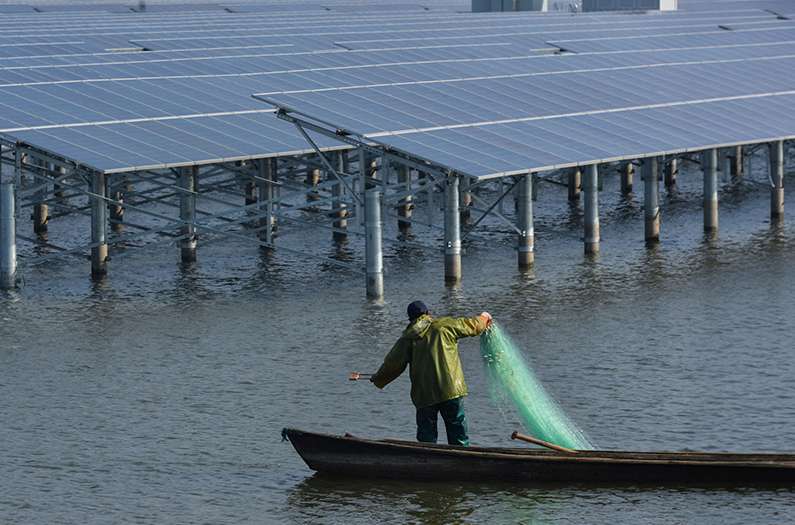
Aquavoltaics, the innovative approach of pairing solar power with fish farming, is gaining traction as an emerging method to tackle the carbon footprint of freshwater aquaculture. Currently, the sector generates over 160 million tons of fish, crabs, and shrimp annually, contributing to approximately 438 million tons of CO2 equivalents (tCO2eq) in emissions.
Scientists have explored various ways to integrate solar power into land use, such as agrivoltaics, where solar panels are spaced across farm fields or pastures, ultimately decreasing crop yields. However, covering lakes, canals, and reservoirs with photovoltaic panels has proven challenging due to their fluctuating levels and large size.
Aquaculture ponds, on the other hand, are generally small, shallow, and maintain consistent water levels, making them more suitable for this application. Researchers analyzed satellite imagery and data to estimate the global area of aquaculture ponds, finding 50,000 square kilometers worldwide, with only 423 square kilometers currently utilizing water-surface photovoltaics.
The majority of this aquavoltaic area is located in China, followed by Vietnam, South Korea, Thailand, and Israel. If all 50,000 square kilometers of ponds were covered with photovoltaics at a 40 percent rate, the researchers estimate that the generated electricity (4,100 terawatt-hours per year) could replace enough fossil fuel-derived energy to reduce aquaculture emissions by 2.5 billion tCO2eq annually—nearly six times the current emissions of the aquaculture industry.
This electricity production would be concentrated along the coastlines of South and East Asia, along with other coastal regions worldwide. Covering aquaculture ponds with solar panels could potentially sustain over 800 small- and medium-sized cities worldwide, particularly in non-industrial regions that are often disconnected from larger power grids.
While these calculations rely on assumptions that may need refinement, the concept of aquavoltaics offers promising potential in driving our transition to renewable energy.
Written by urgent.news from Anthropocene Magazine's reporting — not their text. Machine-written — may contain errors; check the original before relying on it.