New photo reveals an asteroid view that a NASA spacecraft never saw
The Hera mission takes its first close-up of the asteroid pair, Didymos and Dimorphus, that NASA targeted in its 2022 DART mission.
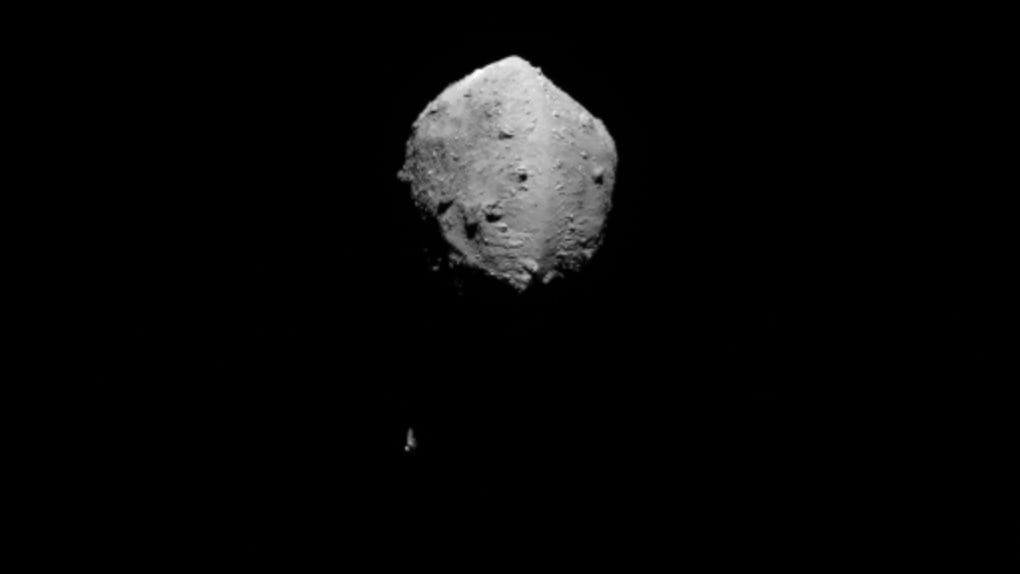
On November 11, European spacecraft Hera sent back its first detailed images of the asteroids Didymos and Dimorphos, previously studied by NASA's DART mission. Hera, designed to investigate the aftermath of DART's impact, captured the first close-up view of Didymos, a half-mile-wide asteroid, from about 37 miles away. Shadow obscures most of Dimorphos, the smaller asteroid orbiting Didymos, but Hera's image reveals the backside of the 500-foot-wide moonlet, which differs significantly from the side previously observed by NASA's DART spacecraft.
Hera's images showcase boulders, craters, and grooves on Didymos' backside, along with a ridge wrapping around its middle. Patrick Michel, Hera's principal investigator, expressed amazement at the new findings, stating, "This feels like looking at a whole new world."
The spacecraft, about the size of a small car, traveled for two years to reach the asteroids, now situated 122 million miles from Earth. Hera's observations will assist scientists in determining the extent of DART's impact, known as the "beta factor," which could help in developing reliable planetary defense tools if Earth ever faces an asteroid threat.
Scientists anticipate Hera's findings will reveal whether the collision caused a deep crater, a shallow dent, or altered Didymos' shape entirely. The small companion probe, Juventas, will scan Dimorphos' interior using radar, akin to taking an X-ray, to examine the asteroid's internal structure. Additionally, Hera will measure the asteroid's mass and density to ascertain its composition, which could explain its reaction during the collision.
Hera's mission aims to transform kinetic impact, or ramming a spacecraft into an asteroid, from a one-time experiment into a dependable planetary defense strategy.
Written by urgent.news from Mashable's reporting — not their text. Machine-written — may contain errors; check the original before relying on it.