Elektromobilität: Ein Hamburger Unternehmer trotzt der Konkurrenz aus China
Florian Walberg ist Pionier bei privaten E-Scootern. Heute drohen Xiaomi und Segway seine Marke zu verdrängen. Um das zu verhindern, geht er an die Grenzen seines Qualitätsversprechens.
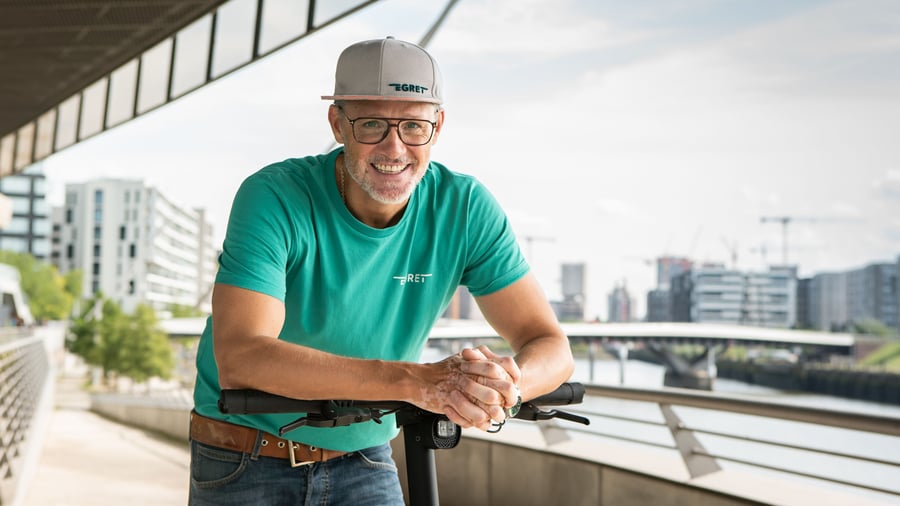
Florian Walberg, a Hamburg businessman, is challenging the competition from Chinese companies in the e-scooter market. His latest e-scooter model, the Egret, can reach speeds of up to 45 km/h and features a built-in seat. Walberg claims that he is the one who introduced the premium model to the market. In a rapidly growing market, Walberg feels the pressure to keep up with innovations as he risks becoming irrelevant if he doesn't innovate.
Walberg is one of the pioneers in the private e-scooter market in Germany. He is credited for allowing private E-Scooters to be driven on German roads. According to economic statistics, the private market for e-scooters is one of the fastest-growing sectors in the mobility industry. The number of private E-Scooters on German roads grew from 571,000 in 2022 to 1.36 million in the previous year, with an annual growth rate of 20 to 30 percent.
Darius Scurtu, a mobility expert at McKinsey, states that the market is still far from being fully exploited. By 2030, the European market for private e-scooters is expected to grow to a two-billion-euro market. The main problem is that the market is dominated by Chinese brands Xiaomi and Segway. Egret founder Walberg wants to prove that there is still room for a German manufacturer in this market.
The story begins with Walberg selling illegal scooters before he started his business. He had previously been a singer in the 90s boyband Bed & Breakfast, a TV moderator, and tried his hand at music and publishing. He sold scooters as a tour manager but they kept breaking down. Walberg started repairing them himself, eventually getting hired by importers to fix other damaged scooters.
After eight years working for the company, he decided to create his own product. Back then, all scooters had a seat, but Walberg believed that for short distances in busy urban areas, a seat was unnecessary. He researched that EU technical standards were responsible for vehicle classes, but there was no working group for his new class of vehicles.
He contacted Segway, which was also interested in the approval of E-Scooters, and together with employees of Decathlon, Segway, Honda, and Toyota, they created a working group to write a norm for the new e-scooters. The initial draft was published in August 2017, and the technical standards were set. However, the road to e-scooter approval was not yet clear.
Once the standard was established, German lawmakers would need to decide on helmet mandates or speed limits and determine whether e-scooters should be allowed on roads or bike paths. Walberg was getting impatient, as he had been selling scooters since 2011, but they were not legal on German roads. He always told customers that they could only be used on private property to avoid liability.
His big chance came in 2019 when e-scooters were officially allowed on German roads. He had already earned nearly eight million euros by that time, and his Egret brand was the only serious player in the private e-scooter market.
Written by urgent.news from Handelsblatt's reporting — not their text. Machine-written — may contain errors; check the original before relying on it.