Vietnam and EU pursue new value chains
Vietnam and the European Union are looking to deepen economic cooperation by developing new value chains accelerating the green transition and improving the quality of trade and investment as their relationship enters a new phase following its elevation to a Comprehensive Strategic Partnership
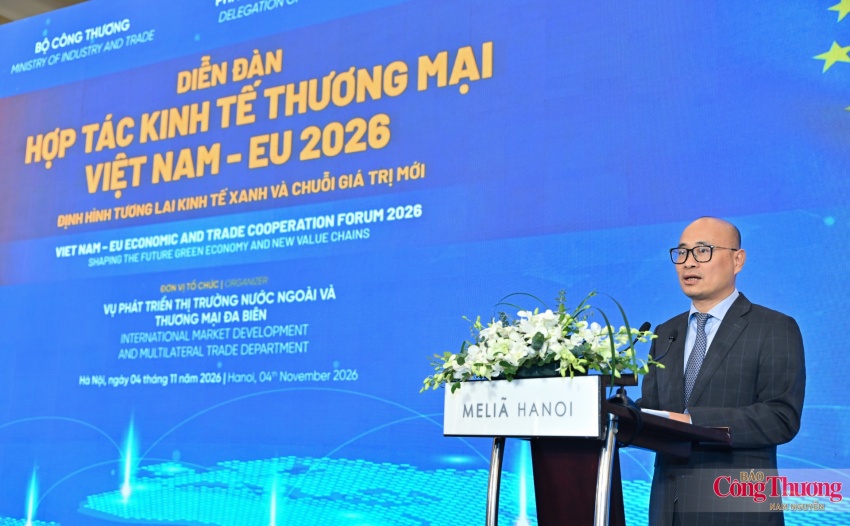
Luong Hoang Thai, Deputy Minister of Industry and Trade, spoke at the Vietnam-EU Economic and Trade Cooperation Forum 2026 in Hanoi. He emphasized the EU's significance as a major strategic partner for Vietnam, considering its market size, technological capabilities, and complementary economic structures. The year 2026 marks a new era in Vietnam-EU relations, with the bilateral ties upgraded to a Comprehensive Strategic Partnership, following the EU-Vietnam Free Trade Agreement (EVFTA) that has sustained robust bilateral trade growth over six years.
Trade between Vietnam and the EU increased to $65.48 billion in the first nine months of 2026, a nearly 20% rise compared to the previous year. The EU currently ranks as Vietnam's fourth-largest trading partner, third-largest export market, and sixth-largest import market, while Vietnam is the EU's largest trading partner within ASEAN and its ninth-largest global goods supplier.
Beyond tariff reductions, the EVFTA has facilitated better market access, capital flow, technology transfer, and supply-chain connections. Looking forward, both sides aim to enhance trade by upgrading trade, developing comprehensive and autonomous supply chains, and boosting sustainability. Vietnam seeks to increase exports of technology-intensive, deeply processed, and higher value-added products to Europe, while also needing European machinery, equipment, materials, advanced technologies, and green solutions.
European partners are called upon to provide technical assistance, facilitate technology transfer, and invest in specific projects, aligning with the development objectives of both sides. Energy cooperation is particularly important. Vietnam acknowledges the EU's contributions to its energy development and transition, including the Vietnam-EU Sustainable Energy Transition Programme and the Just Energy Transition Partnership (JETP).
However, challenges persist despite the strong foundations of bilateral relations and existing trade agreements, such as the EVFTA and the upcoming EU-Vietnam Investment Protection Agreement. Global economic uncertainty, trade competition, protectionism, and non-tariff barriers are exerting additional pressures on businesses. The EU's expanding network of free trade agreements with other partners also means Vietnam cannot solely rely on tariff advantages to maintain competitiveness.
Instead, higher value-added production, adherence to standards, sustainability, and adaptability will increasingly determine how effectively Vietnamese businesses capitalize on European market opportunities.
Julien Guerrier, EU Ambassador to Vietnam, highlighted that stronger economic relations depend on businesses translating political commitments into real investment and commercial projects. While governments create conditions, establish policies, and set rules, businesses ultimately make investment decisions, build partnerships, transfer technology, train workers, and transform these ambitions into reality.
The priority is to ensure shared ambitions are converted into concrete projects and tangible benefits for businesses and people on both sides. The EVFTA is the cornerstone of bilateral economic cooperation, and its full and effective implementation is crucial for unlocking further growth potential. Predictability, transparency, and consistency are essential; investors need a business environment with clear rules, reliable implementation, and efficient procedures.
The EU supports Vietnam's efforts to improve law enforcement, shift from pre-approval controls to risk-based management, and ensure consistent regulation application across provinces. Such reforms would strengthen investor confidence, reduce business costs, shorten project timelines, and attract new high-quality European investors, especially in the green economy and emerging industries.
Written by urgent.news from Vietnam Investment Review's reporting — not their text. Machine-written — may contain errors; check the original before relying on it.