Powered by GPT-6, Unitree humanoid robots master painting, chess without training, says CEO
Robots developed by Chinese humanoid maker Unitree Robotics can now paint pictures and play chess without any prior training, relying on frontier AI models to navigate complex physical tasks, according to founder and CEO Wang Xingxing. Speaking on Thursday at the China International Import Expo (CIIE) in Shanghai, Wang said Unitree’s machines, powered by OpenAI’s GPT-6, were capable of executing…
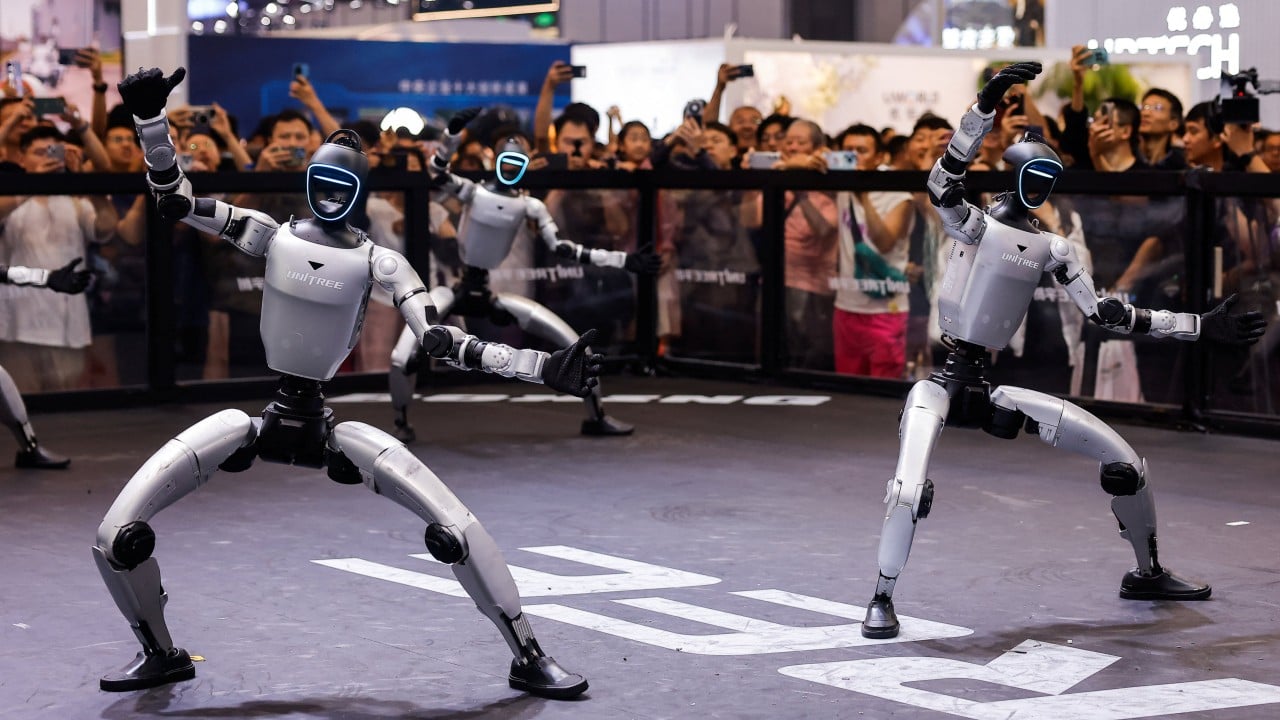
Unitree, a Chinese humanoid robotics company, showcased robots capable of painting and playing chess without any prior training at the China International Import Expo (CIIE) in Shanghai. The machines were powered by OpenAI’s GPT-6, enabling them to carry out complex physical tasks through real-time model inference. Unitree's founder and CEO, Wang Xingxing, expressed amazement at the robots' ability to execute intricate tasks, such as changing brush water and blending pigments, with pinpoint precision.
While the company displayed video footage of the robots' performance, it did not conduct a live demonstration during the presentation.
Wang Xingxing had previously stated that GPT-6 had accelerated the industry's breakthrough timeline to "within one or two years," suggesting that GPT-7 could tackle core challenges in embodied artificial intelligence the following year. However, he acknowledged that translating AI commands into precise physical actions remains a significant challenge.
Wang identified the "last-millimetre" mechanical gap as the industry's most pressing hurdle, predicting that overcoming this physical bottleneck would take another one or two years.
To expedite this transition, Unitree is developing a "self-evolving" feedback loop that allows humanoid robots to write code, run simulations, and autonomously improve their real-world performance. Similar sentiments were echoed by other industry executives at the expo. Wang Qian, founder of X Square Robot, expressed optimism that embodied AI was nearing a watershed moment, forecasting that mass adoption would occur within a year.
X Square Robot founder Wang Qian believed that robots would soon be able to build robots and chips would manufacture chips, leading to true artificial intelligence in the physical world.
However, chip suppliers presented a more measured perspective, highlighting the limitations beneath the software layer. Moore Threads co-founder Wang Dong cautioned that the development of embodied AI continued to lag due to severe data scarcity and prohibitive hardware costs. He noted that collecting real-world interaction data proved challenging, leading developers to rely heavily on synthetic training sets.
To address these issues, Moore Threads was working on supplying its own chips and solutions to domestic robotics developers, as Nvidia chips were prohibitively expensive.
Written by urgent.news from South China Morning Post's reporting — not their text. Machine-written — may contain errors; check the original before relying on it.
This story
This is one outlet's version. Read the fullest account.