Dax-Rekord: Warum deutsche Aktien besonders deutlich von den Midterms profitieren
Die Wahlsiege der Demokraten in den USA stimmen Investoren optimistisch und verstärken die Rotation an der Börse. Der Dax erreicht zeitweise einen Rekord, auch andere europäische Märkte gewinnen.
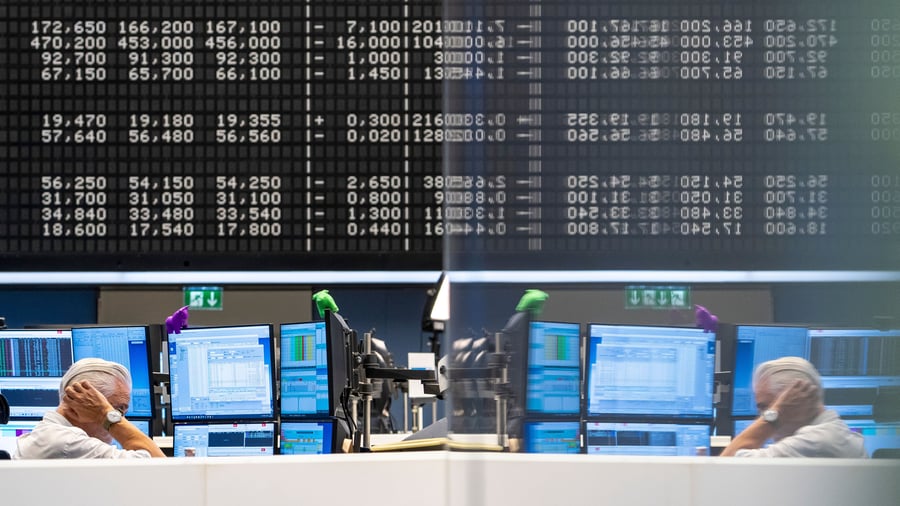
The decisive victory of Democrats in the U.S. midterm elections has relieved investors and triggered a shift towards cyclical stocks, which are more dependent on economic cycles. Germany's leading index, the Dax, and other European stock markets recorded particularly significant price gains. The Dax reached a new record high at 26,692 points on Thursday.
Following the opening of U.S. exchanges, the German leading index lost its daily gains on Thursday but lost less than the U.S. stocks. On Wall Street, concerns about the AI trade returned on Thursday. The S&P 500 index fell more than three percent after the market opened, while the tech-heavy Nasdaq index fell by more than five percent.
The Dow Jones fell more moderately with initially two percent. On the late afternoon, the Dax fell by 0.8 percent. Already on Wednesday, it had approached its best mark since August with a gain of 2.2 percent, the largest daily rise since July. The German leading index rose by just under one percent at the top on Thursday, despite the stock of the defense company Rheinmetall falling by up to 17 percent due to weak figures.
The European leading index Stoxx Europe 600 approached its record high on Thursday, but also slipped into the red for a few points. Stephan Kemper, chief asset strategist at BNP Paribas Wealth Management, attributes the rotation to the midterms to the hope of a rapid de-escalation in the Middle East. Currently, a blockade of the Hormuz Strait by Iran for energy prices that adversely affect many industrial companies is causing concern.
After the opening of U.S. exchanges on Thursday, the hope for de-escalation in the Iran war eased. The price for a barrel of Brent crude fell by more than 16 percent, falling below $100, which has been welcomed by European stock markets as a "liberating blow". A persistently lower oil price and falling freight rates for tankers acted like an immediate stimulus for energy-intensive industries and consumption.
On fixed-income markets, the hope for de-escalation brought relief. Inflation expectations had previously led to high returns, but now the yield on 10-year U.S. treasuries had dropped back below 4.9 percent after rising to over 5.3 percent at the beginning of October. Skepticism about data centers has softened. Many Democratic candidates have made resistance to the boom around artificial intelligence (AI) their main campaign issue.
This is putting massive pressure on the prospects for shares of AI equipment manufacturers. Shares of chip manufacturers, whose products are used in data centers, fell sharply on Wednesday, with the Philadelphia Semiconductor Index, which maps the development of major semiconductor stocks, falling by more than three percent. On Thursday, the index fell by ten percent.
Graphical processor manufacturer Nvidia fell by nearly eight percent on Thursday. Semiconductor manufacturers like Neocloud provider Coreweave also saw significant losses, with Coreweave's stock falling by 14 percent on Thursday. In South Korea, semiconductor chip makers Samsung and SK Hynix fell by eight and nearly ten percent respectively over two days.
In the Dax, this shift towards cyclical stocks was clearly visible, for example with Heidelberg Materials, whose stock had risen by 9.9 percent on Wednesday, gaining another two percent on Thursday. Other winners included long-weakened shares of auto makers, as well as shares of pharmaceuticals and chemicals companies Bayer and BASF.
Jim Reid, chief macro strategist at Deutsche Bank, sees a "major shift from data centers to everything else worldwide". The rotation could go even further, according to Markus Reinwand, equity strategist at Helaba. "We have seen a certain skepticism towards AI all year long. After all, the expectations for the industry are very high and companies must meet the high earnings expectations."
Reinwand expects companies that use AI to become more profitable to benefit in the future. Germany could also benefit from this, as companies increasingly use AI for robotics. The upturn of the German market remains intact.
Written by urgent.news from Handelsblatt's reporting — not their text. Machine-written — may contain errors; check the original before relying on it.