The fatal assumption behind Republicans' redistricting strategy
Data: The Downballot , Ballotpedia , AP ; Chart: Erin Davis/Axios Republican mapmakers thought they were drawing at least a dozen comfortably red districts to protect their House majority. Why it matters: They weren't red enough . In the seven states where Republicans redrew congressional boundaries, the GOP is on track to lose as many as eight seats — rather than gain the 15 it had hoped to pick…
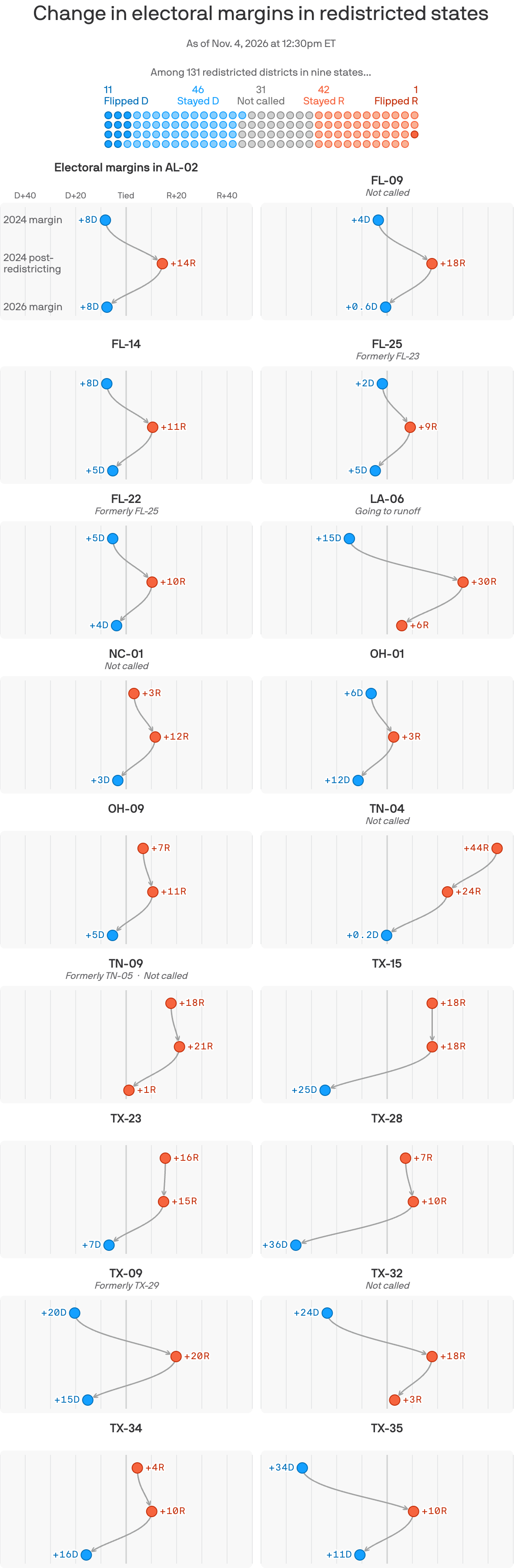
The Republican party's approach to redistricting for the 2026 elections proved to be a fatal miscalculation. Initially, they believed they would create at least a dozen districts that would exceed the Republican vote share, thereby safeguarding their majority in the House of Representatives. However, their strategy backfired, leading to potential losses of up to eight seats instead of the anticipated gains of 15.
In the seven states where Republicans redrawn congressional boundaries, the GOP's optimistic predictions did not materialize. Only two districts, TX-32 and TN-09, managed to flip as expected. In North Carolina, the party suffered a significant defeat. The Republicans' error lay in their assumption that the 2026 electorate would behave similarly to the voters in 2024. Instead, voters' behavior resembled that of 2020 or even 2018.
The GOP's heavy losses were observed in Ohio and North Carolina, where they made minimal changes to Republican-held districts. Their strategy focused on making two Democratic-held seats in Ohio and one in North Carolina redder, hoping to flip them in a typical election year. However, 2026 proved to be an aberration.
One of the clearest examples of this flawed strategy was seen in Tennessee's 4th District. Republicans altered the district's Republican vote share from an overwhelming 44% to 24%, thereby diminishing the Republican majority. Democrat Victoria Broderick narrowly won the seat by just 280 votes, illustrating the dangers of "dummandering" – a term used when mapmakers spread their own voters too thinly in an attempt to secure additional seats.
Written by urgent.news from Axios's reporting — not their text. Machine-written — may contain errors; check the original before relying on it.