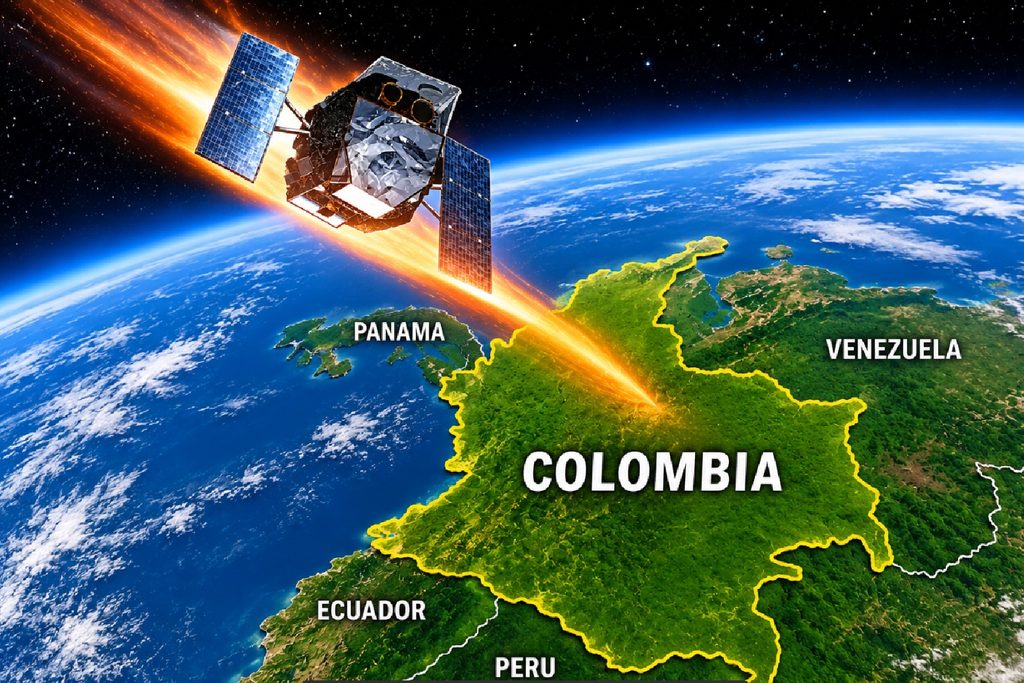
NASA space telescope plunges to Earth after two decades studying cosmic explosions
One of NASA's premier space telescopes plunged to Earth on Wednesday, ending its 22-year investigation of the universe's biggest explosions.

A 22-year-old space telescope, the Neil Gehrels Swift Observatory, is on track to burn up in Earth's atmosphere on November 4, 2026. This spacecraft, originally known as the Swift Gamma-Ray Burst Explorer, has been an indispensable tool for astronomers tracking rapidly changing events in space.
Swift was launched into low Earth orbit in 2004 and was designed to swiftly follow up on explosive events called gamma-ray bursts and their afterglows. It sports three onboard telescopes and its name reflects its agility, as it can pivot quickly to observe fleeting cosmic phenomena.
The observatory has made significant contributions to various fields of science. Swift detected its 1,000th gamma-ray burst just ten years after its science operations began. Its ability to swiftly pivot its telescopes, known as slewing, enables it to cover an area of 50 degrees in under 75 seconds, a feat that would take the Hubble Space Telescope approximately 15 minutes to accomplish.
While gamma-ray bursts are its most famous targets, Swift has observed other transient phenomena, such as supernovae, X-ray flares from binary stars, and even the electromagnetic counterparts to gravitational waves. Swift played a crucial role in connecting high-energy neutrinos detected by the IceCube Neutrino Observatory to a supermassive black hole in 2017.
As the Sun becomes more active and Swift's journey nears its end, this steadfast observer is set to make its final descent upon Earth.
Written by urgent.news from The Conversation's reporting — not their text. Machine-written — may contain errors; check the original before relying on it.
This story
This is one outlet's version. Read the fullest account.
- NASA’s Swift Observatory is about to burn up in the atmosphere – the indispensable telescope helped astronomers track fast-moving events in space theconversation.com
- NASA asks industry for ideas about saving Hubble Space Telescope space.com
- Swift has fallen: NASA's 22-year-old space telescope burns up over Sumatra livescience.com
- NASA is racing against time to save the Hubble Space Telescope sciencedaily.com
- NASA space telescope plunges to Earth after two decades studying cosmic explosions winnipegfreepress.com
- Voting in space: NASA astronauts vote from ISS r.smartbrief.com
- SpaceX no longer needs NASA, and that's a problem for America's space agency arstechnica.com