Artificial mangrove roots offer temporary shield for Thailand’s eroding coastline
Coastal communities near Bangkok in Thailand are testing artificial mangrove roots to combat severe shoreline erosion, reports Mongabay’s Carolyn Cowan. The shorelines of Phra Samut Chedi district, located in the Chao Phraya River Delta where Bangkok’s main waterway empties into the Gulf of Thailand, is especially vulnerable to erosion. Each year, strong surges claim 20 […]
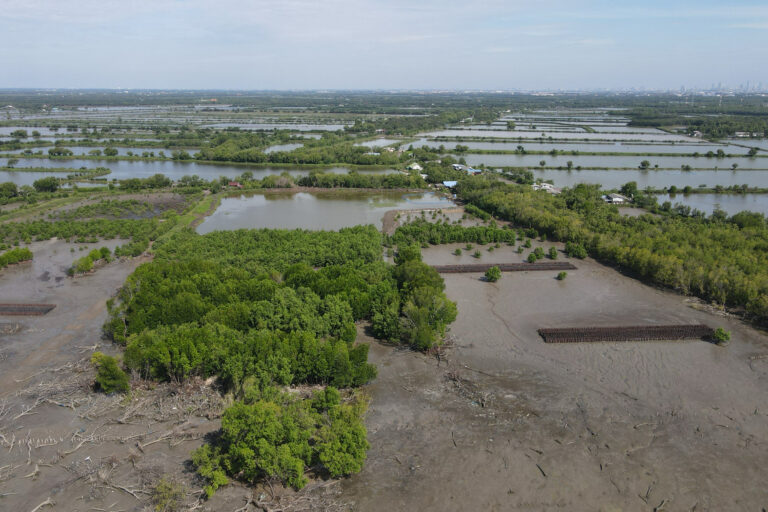
Coastal towns near Bangkok, Thailand are piloting artificial mangrove roots to counteract rapid shoreline erosion, according to a report by Mongabay’s Carolyn Cowan. The shoreline of Phra Samut Chedi district, situated in the Chao Phraya River Delta where Bangkok’s primary waterway meets the Gulf of Thailand, faces heightened erosion risks.
Powerful surges annually claim 20 to 60 meters (66 to 200 feet) of land, with powerful waves frequently demolishing dikes and submerging aquaculture farms. Numerous approaches to safeguarding the coast, such as mangrove restoration and bamboo barriers, have proven ineffective. Recently, researchers assessed a novel strategy: deploying artificial mangrove root systems designed to replicate the shape of natural mangrove roots, to determine if these could also mimic their protective qualities and mitigate land loss due to ocean encroachment.
A 15-month trial conducted at 11 sites in Phra Samut Chedi and other regions of Samut Prakan province yielded promising results, as reported in a recent study. The engineered mangrove roots managed to collect 16 to 88 centimeters (6 to 35 inches) of sediment behind them at 10 locations. Unlike rigid-engineered structures or short-lived bamboo fences that decompose into marine detritus, the artificial mangrove roots' composite wood-plastic and rubber components permit water passage.
This design generates localized turbulence, stimulating suspended silt to deposit onto the seabed, explained the researchers. "Aquaculture farmers provided us with a video of the waves striking their dikes," Butsawan Bidorn, the study's senior author and an assistant professor of coastal engineering at Chulalongkorn University, stated.
Written by urgent.news from Mongabay's reporting — not their text. Machine-written — may contain errors; check the original before relying on it.