Vietnam must be more strategically proactive amid global uncertainty: PM
Vietnam will strengthen its economic resilience, strategic autonomy, and international partnerships as global uncertainty deepens, Prime Minister Le Minh Hung said at a dialogue with the World Economic Forum's CEO.
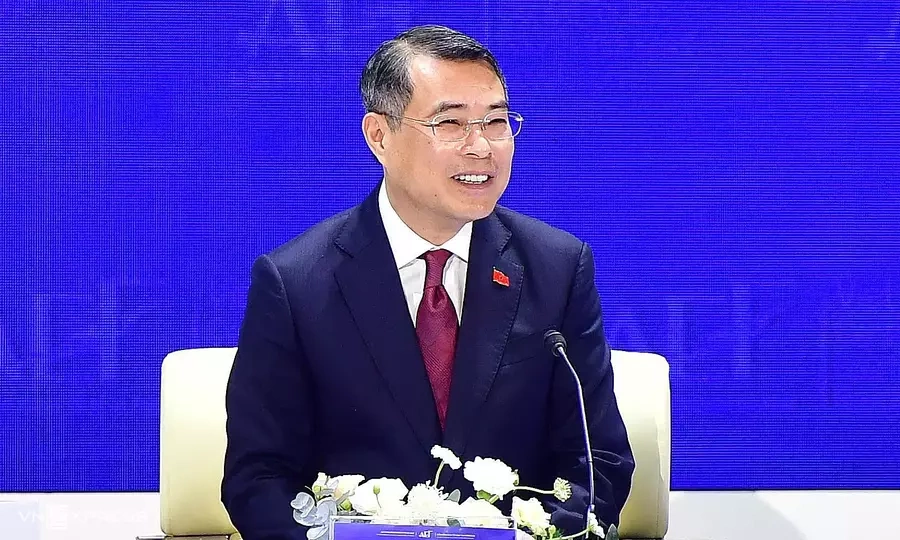
Vietnam must adopt a more proactive strategic approach, enhance its domestic capabilities, and foster international collaboration as global economic and geopolitical uncertainties increase, stated Prime Minister Hung. Addressing the 2026 Autumn Economic Forum in Ho Chi Minh City, Hung discussed Vietnam's strategy for the next decade in response to shifting global dynamics.
The 60-minute discussion, a key event at the forum, was moderated by WEF CEO Stephan Mergenthaler. Mergenthaler inquired about Vietnam's perspective on global changes and their impact on the nation's development. The Vietnamese leader highlighted the ongoing global transformation, citing the shifting balance of power, intensifying strategic competition, and the rise of multipolar international order.
He emphasized that while globalization persists, it is becoming more fragmented, with a heightened focus on security, self-reliance, and resilience. Furthermore, rapid advancements in science, technology, and artificial intelligence are disrupting production, governance, and economic advantage distribution. These changes present significant challenges, such as the need to reform international institutions and rules, diminishing strategic trust due to escalating competition, and the diminished efficacy of conventional growth models, particularly in developing economies.
To cope with these uncertainties, Vietnam must become more strategically proactive, bolster its internal strengths, and broaden cooperation, according to Hung. He outlined five priorities to bolster Vietnam's economic resilience: maintaining political and social stability while fortifying macroeconomic fundamentals; implementing institutional reforms to align the legal framework with global standards and remove business and investment barriers; expediting infrastructure development, especially in transport, ports, energy, and other critical sectors; enhancing technological capabilities and linking domestic and foreign-invested enterprises; and attracting selective investments to promote technology transfer and workforce development.
Additional priorities include improving education and training quality, and expanding foreign relations while diversifying partnerships to generate more growth opportunities. Mergenthaler also asked how Vietnam could maintain strategic autonomy amidst declining international trust and growing competition among major powers. Hung clarified that strategic autonomy entails building domestic capabilities to ensure the country's ability to make independent decisions and choose partnerships that serve national interests, all while respecting the legitimate interests of other nations.
Vietnam will concentrate on boosting economic competitiveness, supporting domestic businesses, and progressing science, technology, and innovation. It will also safeguard national sovereignty and security, including energy, food, environmental, and human security, while diversifying essential supply chains to mitigate exposure to external shocks.
Simultaneously, Vietnam will engage in international integration and leverage its 18 signed free trade agreements to access broader markets, diversify partners, and attract capital, technology, and knowledge. Vietnam's aspirations for the evolving global economic landscape through 2035 include becoming a hub for digital technology, new and green energy, and green agriculture, as well as contributing more to regional and global growth.
Vietnam seeks to become a crucial and dependable link in regional and global supply and value chains, along with emerging growth centers. The country's strategic geographical location, political and macroeconomic stability, and economic growth performance are identified as three key advantages supporting these ambitions. Vietnam is entering a new development phase with ambitious objectives and a strong commitment to implementation as the global economy experiences significant restructuring.
The nation possesses a sufficiently diversified domestic economic foundation to engage in and contribute to emerging growth networks. Vietnam's strengths, such as human resources, manufacturing capabilities, markets, and other resources, provide an essential foundation for the country not only to receive investment and technology but also to generate value, develop technology, and create new growth drivers.
Written by urgent.news from VnExpress Business's reporting — not their text. Machine-written — may contain errors; check the original before relying on it.