TB 26-09 Measured Hammer-Tap Inputs
For more information, contact Joel W. Sills, Langley Research Center, joel.w.sills@nasa.gov. Download the PDF version An instrumented hammer test does not require an idealized single half-sine waveform. When the complete force and response are measured accurately, crest ripples and separated contacts remain known inputs. Force shape changes excitation, but does not inherently invalidate the…
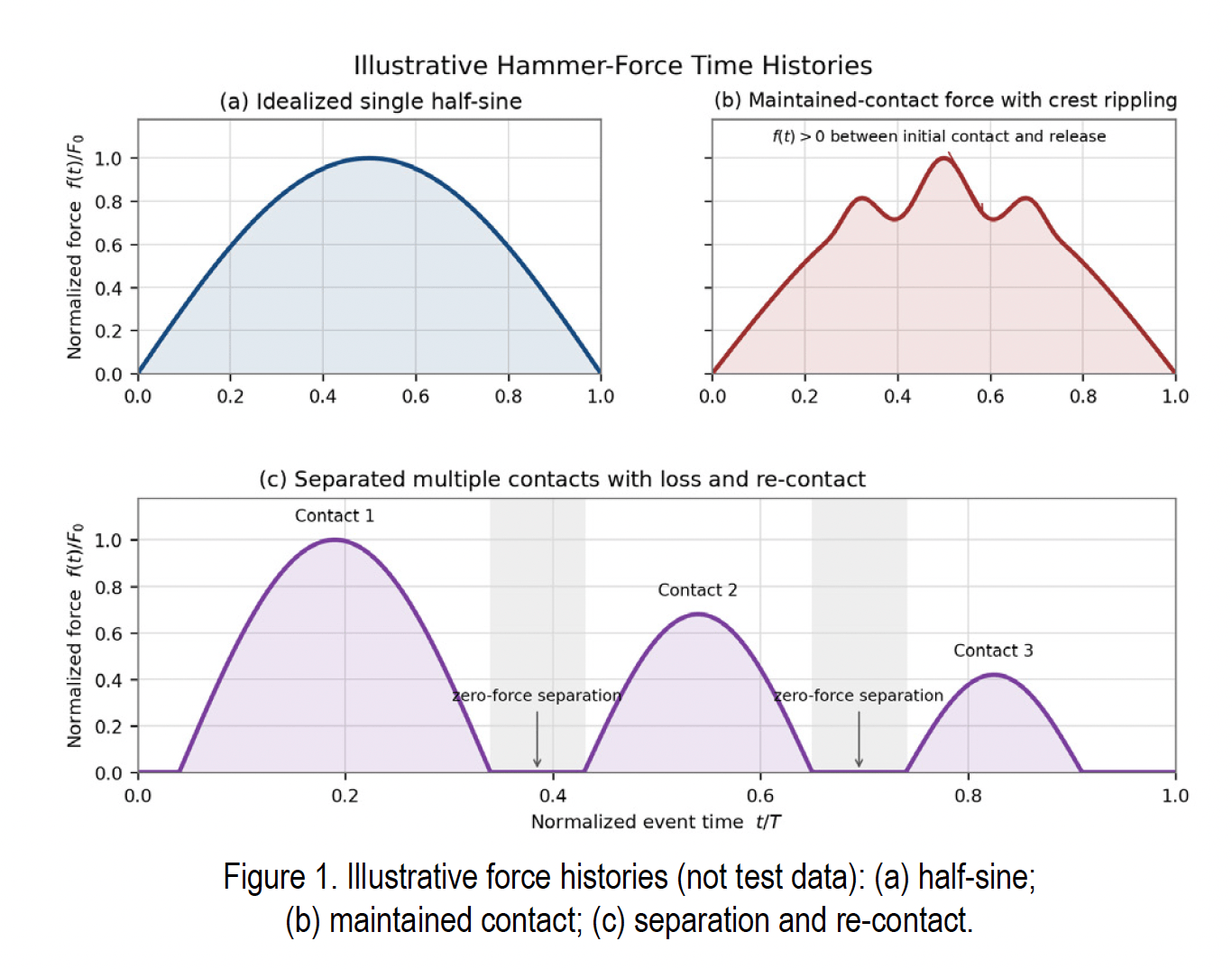
A NASA instrumented hammer test demonstrates that measured force and response data must be evaluated as a whole, rather than relying on the appearance of a half-sine waveform. While a half-sine is broadband, it contains spectral zeros at certain frequencies, which may not provide adequate excitation for all structural responses. Crest rippling and timing between separated contacts can add content and create deterministic interference, potentially filling half-sine notches.
To ensure test adequacy, the complete applied force should be measured with adequate bandwidth, calibration, dynamic range, and time synchronization. The response measurements must also have adequate bandwidth and signal-to-noise ratio, without being clipped or saturated. The excitation must cover the frequency, amplitude, and nonlinear-response ranges required by the intended test objective.
Ultimately, a hammer test should be judged by its purpose and by accurate, complete force and response measurements over the required range. Validity and predictability depend on the measured force history, not just the waveform shape. By following these guidelines, researchers can ensure that hammer tests provide reliable and meaningful data for modal analysis and pyroshock testing.
Written by urgent.news from NASA Science's reporting — not their text. Machine-written — may contain errors; check the original before relying on it.
Also reported by 1 other outlet
- TB 26-09 Measured Hammer-Tap Inputs nasa.gov