Sri Lanka's war widows still search for the missing
SEATED outside a church, Saradhadevi Thadcanamoorty recites four handwritten pages of names — 124 husbands, fathers and brothers who vanished during Sri Lanka’s civil war.
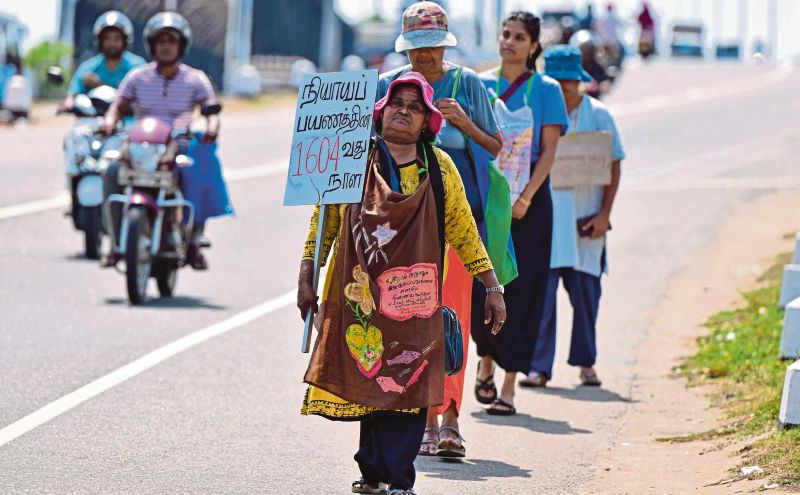
Saradhadevi Thadcanamoorty, a Tamil woman in her sixties, recently marched for justice in Batticaloa, Sri Lanka, alongside three others. They have been engaged in this protest for 1,604 consecutive days, commemorating the 124 husbands, fathers, and brothers who vanished during Sri Lanka's civil war that lasted from 1983 to 2009.
The conflict pitted government forces, representing the Sinhalese majority, against Tamil separatist rebels, an ethnic minority with Hindu beliefs. Over 100,000 people perished, with many more disappearing, abducted, tortured, or killed by security forces or the Liberation Tigers of Tamil Eelam (LTTE). Despite 15 years post-war, the fate of most remains unknown.
Thadcanamoorty's husband Nallathambi was found dead in his field, shot in the head in 1992. Authorities initially refused to return his body, claiming it would never be given back. She filed a complaint against an unnamed individual but received only 50,000 rupees in compensation and the investigation ceased. Her son, Navaneethan, disappeared in 2000, believed to have been abducted by Tamil rebels. She filed a request for information but received only a certificate of disappearance without answers.
Lakshmi Silva, another victim, lost her husband in 1990 while he was traveling by bus to Colombo. Armed men took him away at a checkpoint, with witnesses identifying them as members of the LTTE. Authorities issued her a death certificate in 1994, stating the cause of death as unknown. She has since focused on her children, stating, "I live only for my children now."
Other women, such as Rajeshwari Chithiravadivel, remain hopeful despite the lack of progress. Chithiravadivel's husband disappeared in 1989 after being abducted by masked men while shopping. The authorities later presented her with the body of an unidentified man for identification, which she confirmed as her husband's. The women's persistent protests echo the efforts of Argentina's Mothers of the Plaza de Mayo, who have marched for years demanding answers about their disappeared loved ones.
Despite international pressure, progress remains slow as successive governments are hesitant to address the issue, fearing repercussions.
Written by urgent.news from New Straits Times's reporting — not their text. Machine-written — may contain errors; check the original before relying on it.