Rethinking Computer Science Education: Why Students Should Build Before They Master Theory
Computer science students learn theory before building real software. In the AI era, should we reverse the curriculum and teach through practical experience?
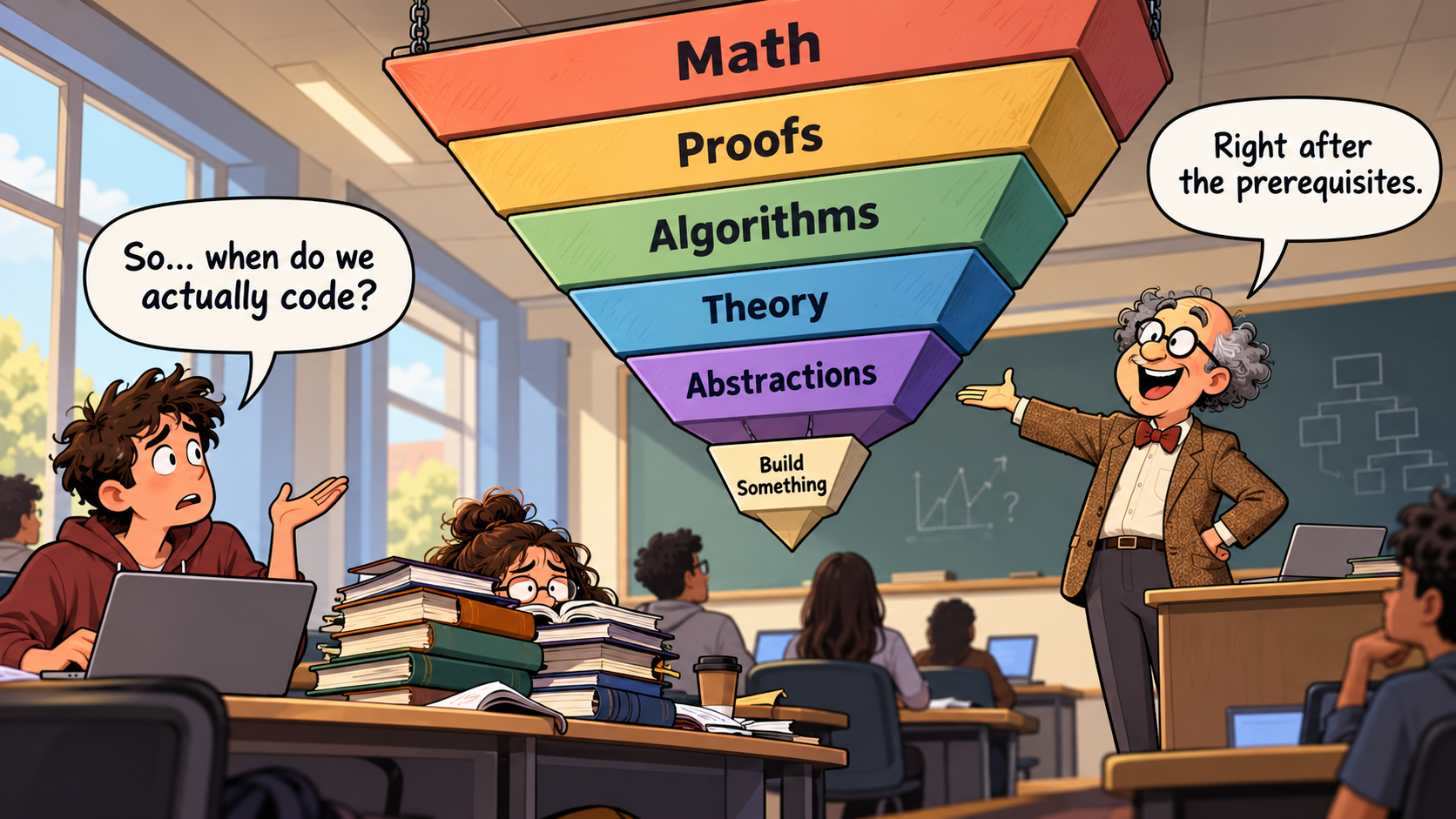
Traditionally, computer science education begins with the foundational topics of programming, mathematics, algorithms, data structures, databases, operating systems, networks, and software engineering. Students are expected to master these areas before they are allowed to apply their knowledge to building real-world software. However, this order may no longer be the most effective approach.
With the advent of artificial intelligence, the process of building software has become much simpler. Students can now create functional applications with minimal technical knowledge. All they need is a basic understanding of a programming language, access to APIs and cloud services, and a few other tools. Within weeks, they can produce a functional app ready to be shared with others.
When these students enter a traditional lecture hall, they are often told to put their hands on the brakes. The conventional wisdom is to first learn the foundational concepts, and only then apply them to building practical software. However, this approach is out of sync with the realities of the modern job market.
Employers are looking for graduates who can demonstrate their ability to build real-world software using modern tools and technologies. In interviews, candidates are often asked not about their deep theoretical knowledge, but their ability to create something tangible using the tools provided by the company.
Therefore, it may be more effective to flip the order of computer science education. Instead of starting with the foundational topics and then building up to practical application, students should be encouraged to create useful software early on. They should be taught just enough modern tooling, APIs, databases, AI, testing, and deployment to ship real systems.
Once students have experienced the joy of building something that works, they will be more motivated to delve into the deeper theory. The subjects that were once considered boring or abstract will suddenly become relevant and interesting. They will see how the problems they encountered while building their software can be solved using the theoretical concepts they have been learning.
This approach flips the traditional pyramid of computer science education on its head. Instead of starting with theory and then applying it to practice, students start with practice and then build up to theory. This way, the deep knowledge and understanding become more valuable as AI takes over routine implementation tasks.
It does not mean that the foundational topics are no longer important. On the contrary, as AI handles routine implementation, the hard problems related to performance, scale, reliability, security, and edge cases become even more crucial. These are the areas where deep knowledge and understanding truly shine.
The real question is not whether all of the foundational topics have to come first, but rather whether they have to come first at all. Perhaps the best way to discover the value of deep computer science is to build useful software first. In this way, students can learn the theory in the context of real-world problems, making it more engaging, relevant, and valuable.
Written by urgent.news from HackerNoon's reporting — not their text. Machine-written — may contain errors; check the original before relying on it.