Explaining the War and Re-educating the Liberal: The New Canon of Pro-War Cinema
Dmitry Kamyshenko on Russian propaganda films about the war in Ukraine
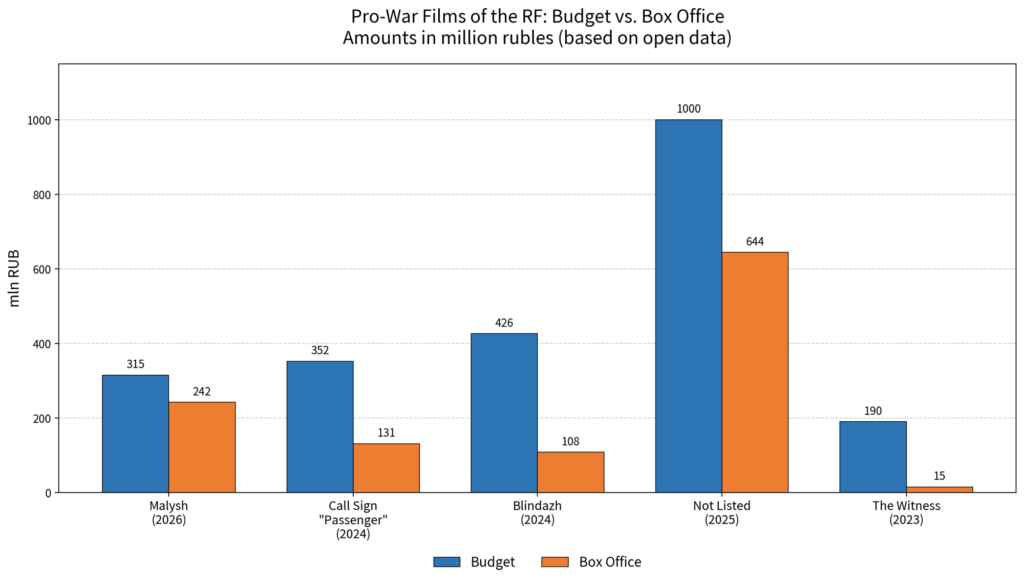
In August 2023, the film The Witness premiered, marketed as "the first feature film about the war in Ukraine." However, this claim was untrue. Earlier, in October 2022, the action film The Best in Hell was released, and in spring 2023, the web series Mobilization premiered. Over the following years, more than a dozen projects about the war with Ukraine were produced.
Many of them addressed events from 2014 to 2022, including series like Take Her Across the Maidan, Militia Romance, Our Own: A Ballad of War, and Ten Days Before Spring, as well as films like Call Sign "Passenger." Other projects dealt with the full-scale war, such as Mobilization, 20/22, Reservists, and Lilies of the Valley; films like The Best in Hell, Aldan, and The Kid; and, in October 2026, the series The Other Side of the Coin premiered.
A distinctive canon of pro-war cinema emerged, featuring projects of varying scales and budgets, ranging from Mobilization, produced on a minimal budget, to Call Sign "Passenger," which cost 351 million rubles ($4.33 million) to make. The primary purpose of these films, as explained in Channel One's series 20/22, was to "explain why the war began."
Nearly every film or series offered an explanation for Russia's decision to launch the full-scale war. Screenwriters could draw from different propaganda narratives. 20/22, Mobilization, and The Kid attributed the war to Ukraine's alleged preparation for an attack on the DNR, positioning Russia as the protector of the Donbas civilian population.
The rescue motif, where the Russian army saves civilians, provided a straightforward plot structure, even if the causal logic sometimes became distorted and farcical. For instance, in The Witness, Azov Battalion fighters captured Ukrainian civilians just after Russia attacked Ukraine, explaining that only the Russian army could save them.
Conversely, Russian cinema presented alternative explanations, such as the war stemming from a U.S.-initiated geopolitical game in films like Take Her Across the Maidan and Call Sign "Passenger," where Ukrainian soldiers were portrayed as pawns of external forces. Other narratives included "contract with the Motherland" in The Best in Hell, a sense of duty in Lilies of the Valley, and revenge in Aldan.
Many films spent significant screen time explaining the war's origins through archival footage, narration, and character monologues. This emphasis on explaining the war's causes distinguished contemporary Russian cinema from its Soviet predecessor, where characters defended their homes without needing to parse geopolitical contexts.
The "liberal" archetype was a popular character type in pro-war Russian cinema. These individuals, often portrayed as music producers, trendy writers, spoiled rich girls, or journalists, were depicted as residing in Moscow and living comfortably amidst destruction. Their anti-war stance proved untenable as they were forced to explain their opposition through slogans and eventually embraced patriotism.
In 20/22, an anti-war student character joined the front to find her boyfriend, while in Aldan and Militia Romance, the plot involved personal tragedies driving characters to volunteer. Call Sign "Passenger" featured a similar transformation for a Moscow journalist. These narratives of re-educating the liberal were also prevalent in Russian propaganda journalism, exemplified by the "IT specialist's letter" published by Komsomolskaya Pravda.
Written by urgent.news from Riddle Russia - Politics's reporting — not their text. Machine-written — may contain errors; check the original before relying on it.