At Kazakhstan forum, Pakistan presents Karachi and Gwadar ports as 'strategic gateways' for Central Asian trade
ISLAMABAD: Pakistan can serve as an important trade and transit corridor for the landlocked Central Asian countries, providing them with access to international maritime trade routes and global markets, Minister for Board of Investment (BoI) Qaiser Ahmed Sheikh said on Monday. He made the remarks while addressing the opening session of the Second Tianshan Forum for Central Asian Economic and…
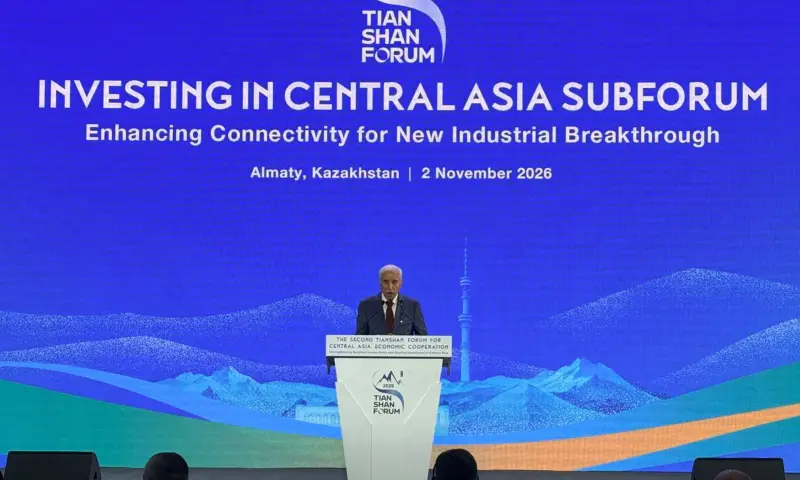
Pakistan can serve as a crucial trade and transit pathway for landlocked Central Asian countries, granting them access to global maritime trade routes and international markets, asserted Investment Board Minister Qaiser Ahmed Sheikh on Monday. Speaking at the opening of the Second Tianshan Forum for Central Asian Economic and Quality Investment in Kazakhstan's Almaty, Sheikh emphasized Pakistan's three major seaports—Karachi Port, Port Qasim, and Gwadar Port—as "strategic gateways to facilitate regional trade, enhance transportation links, and provide alternative routes for goods movement."
The minister underscored Karachi’s significance as Pakistan's leading industrial and commercial center, noting its established industrial base, business infrastructure, financial institutions, and port facilities as key drivers of trade, industrial collaborations, and foreign investment. Gwadar's potential to further bolster regional connectivity and economic cooperation was also highlighted.
Sheikh invited investors to explore opportunities in energy, infrastructure, logistics, transportation, manufacturing, and trade, emphasizing that improved connectivity and dependable energy supplies were vital for unlocking the region's economic potential. He acknowledged the Central Asia Regional Economic Cooperation (Carec) Programme's role in promoting transport connectivity, enabling trade, and fostering economic integration among participating nations.
Pakistan's strategic location, youthful population, industrial capacity, and seaport infrastructure, according to Sheikh, place the country in a prime position to serve as a conduit connecting Central Asian economies with global markets. The forum, concluding in Almaty on Tuesday, is themed "Strengthening Resilient Connectivity and Quality Investment in Central Asia."
The two-day event, a follow-up to the inaugural Tianshan Forum for Central Asian Economic Cooperation, aligns with the new Carec Institute Strategy 2026–2030 and the Carec 2030 Strategy Midterm Review Rolling Implementation Action Plan. The agenda highlights the uncertainty of the external environment, including rising geopolitical tensions leading to energy and food price hikes, disrupted transport and logistics, and weakened trade corridor reliability.
Despite limited intra-regional trade due to similar economic structures, weak production complementarities, and incomplete market opening, regional transport and logistics bottlenecks like uneven infrastructure quality, fragmented asset management, and capacity mismatches keep trade costs high. Non-physical barriers such as inconsistent customs procedures, weak digitalization, non-harmonized standards, and inefficient border operations further impede cross-border flows.
Rapid digital infrastructure expansion, including cloud services, data centers, and AI applications, is reshaping connectivity and competitiveness. Carec countries face uneven progress, with significant gaps in backbone infrastructure, digital skills, and regulatory coherence. Bridging these gaps is essential to support inclusive growth, resilient connectivity, and regional integration.
High-level representatives from multilateral development banks, financial institutions, policymakers, business leaders, local governments, and academia across Carec countries are attending the forum to address policy and operational issues in areas like transport, trade, logistics, energy, and digital connectivity, promoting pragmatic and sustainable investments in the region.
Written by urgent.news from Dawn's reporting — not their text. Machine-written — may contain errors; check the original before relying on it.
This story
This is one outlet's version. Read the fullest account.