A Newly Discovered Trail of Cosmic Debris Illustrates How the End of the Solar System Could Look
A dying star 1,600 light-years from Earth is surrounded by two rings of gas and dust that astronomers believe are the remnants of the planetary bodies it once hosted.
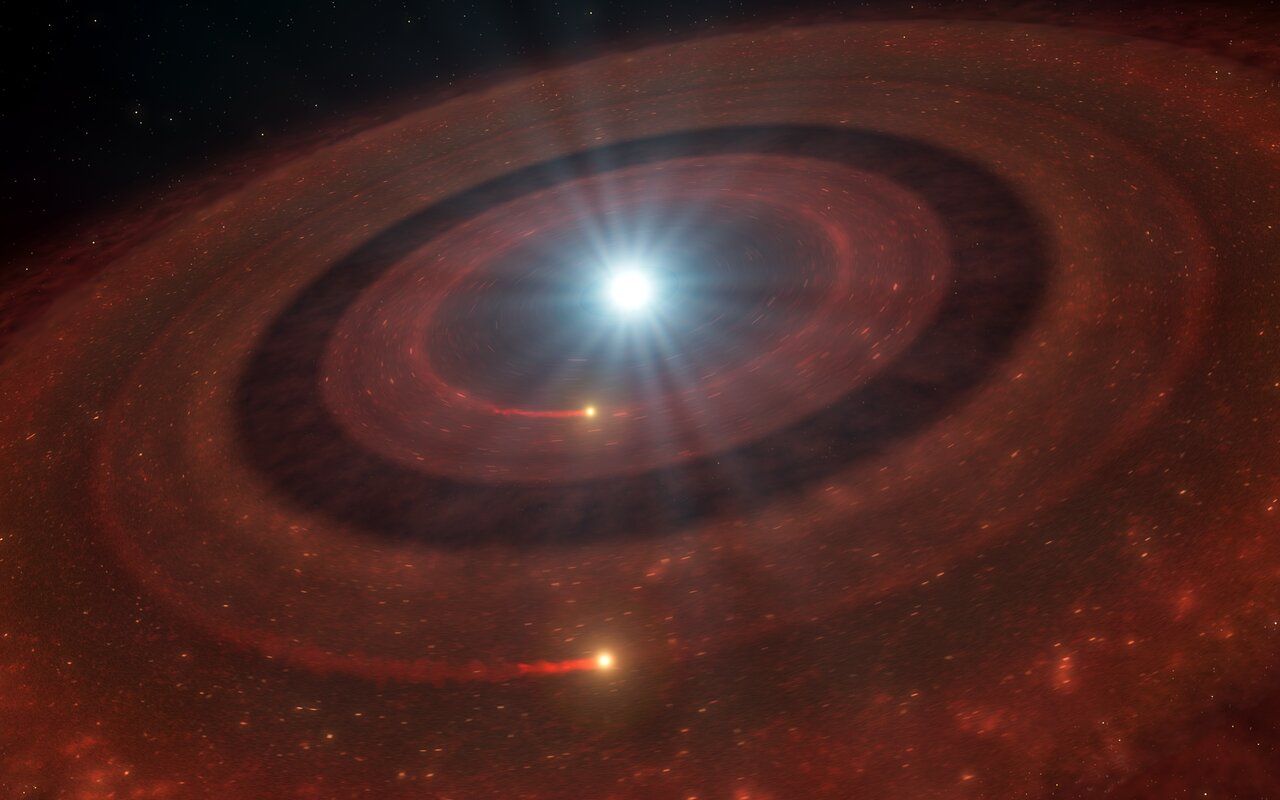
The white dwarf J1328−1450, situated approximately 1,600 light-years away from Earth, has recently captured astronomers' attention due to its unique surroundings. Previous star-mapping catalogs had already identified this celestial object, but fresh observations from the ESO’s Very Large Telescope unveiled an unusual disk of debris surrounding it. This disk exhibits two distinct rings of gas, separated by a void, which scientists believe to be remnants of a former planetary system orbiting J1328−1450.
As the white dwarf transitioned from a red giant phase to a white dwarf, astronomers speculate that the star may have destroyed some of its planets, leaving behind exposed rocky bodies subjected to harsh conditions. These remnants eventually coalesced into a disk of gaseous and dust particles encircling the dying star. The formation of this debris disk mirrors processes that may occur in our own solar system as well.
In roughly 5 billion years, our Sun will run out of fuel and expand into a red giant, potentially engulfing nearby celestial bodies, including the closest planets. Subsequently, it will shed its outer layers, leaving behind a white dwarf like J1328−1450. Any surviving rocky bodies could break apart and form a debris disk around the dead star, similar to what astronomers are currently observing.
The observed two debris rings, however, raise intriguing questions. Their structure appears to be influenced by celestial bodies not directly identified. The data suggest that at least two planetary objects may have survived the star's transformation. One of these objects might be diminutive, measuring just a few kilometers in diameter, while the other could rival Pluto or even our Moon in size.
The interaction between these objects and the surrounding material could explain the rings' formation, although this has yet to be confirmed as separate entities.
Alternatively, it is possible that the observed ring structure originates from different sections of a singular planet-like body, such as its crust and core. This narrative originally appeared on WIRED en Español and has been translated from Spanish.
Written by urgent.news from Wired's reporting — not their text. Machine-written — may contain errors; check the original before relying on it.
This story
This is one outlet's version. Read the fullest account.