A Newly Discovered Trail of Cosmic Debris Illustrates How the End of the Solar System Could Look
A dying star 1,600 light-years from Earth is surrounded by two rings of gas and dust that astronomers believe are the remnants of the planetary bodies it once hosted.
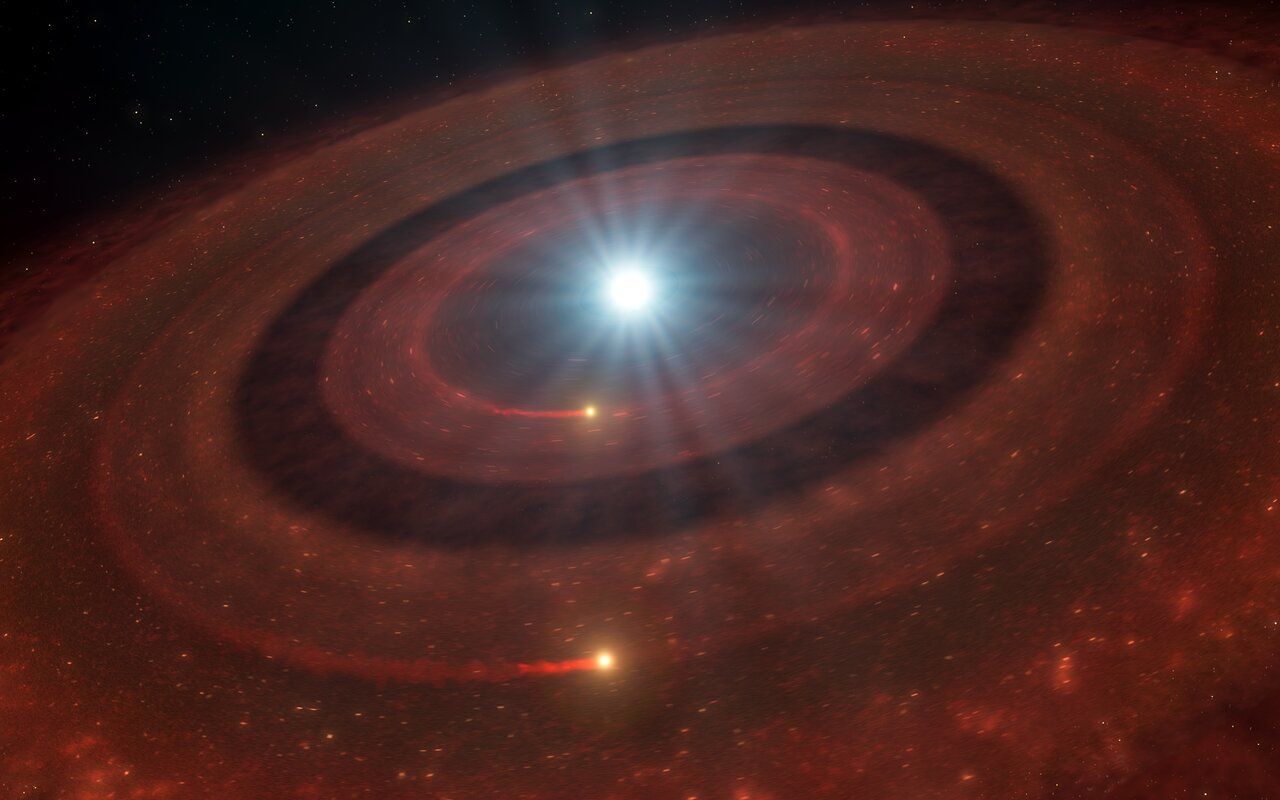
The white dwarf J1328−1450 resides approximately 1,600 light-years away from Earth. While astronomers had prior knowledge of its existence due to star-mapping catalogues, new observations made with ESO’s Very Large Telescope revealed a disk of debris encircling the star. What sets this disk apart is its unusual structure, characterized by two distinct rings of gas separated by a gap.
This material disk is believed to be the aftermath of the planetary system once orbiting J1328−1450. As the star traversed through a red giant phase and subsequently evolved into a white dwarf, it likely destroyed certain planets and exposed other rocky bodies to an extreme environment. Consequently, some of the expelled material coalesced into a disk of gas and dust surrounding the dormant star.
This formation process may parallel our own solar system's fate. In around 5 billion years, our sun will deplete its fuel and expand into a red giant, potentially engulfing nearby celestial bodies, including the closest planets. Following this phase, it will shed its outer layers, resulting in the emergence of a white dwarf. Any surviving rocky bodies could fragment and generate a debris disk akin to the one currently observed around J1328−1450.
However, the presence of the white dwarf's two debris rings raises an intriguing possibility. Their distinctive arrangement seems to be influenced by bodies that astronomers have yet to identify directly. The data imply that, post the star's transformation, at least two planetary objects may have endured amidst the remnants of the system.
Researchers speculate that these two entities could exhibit significant size differences. The nearer object would measure only a few kilometers across, whereas the more distant one could span a size equivalent to Pluto or even the moon. Their interaction with the surrounding material could account for the formation of the two rings, although confirmation of their existence as distinct objects has not been established.
Alternatively, the observed structure might stem from different segments of a single planet-like body, such as its crust and core.
Written by urgent.news from Wired Science's reporting — not their text. Machine-written — may contain errors; check the original before relying on it.