BoG turns to AI to strengthen financial-sector oversight
The Governor of the Bank of Ghana (BoG), Dr Johnson Pandit Asiama, has called for a dedicated digital platform to make the country’s official statistics more accessible, saying wider access to reliable data could improve economic research, policymaking and investment decisions.
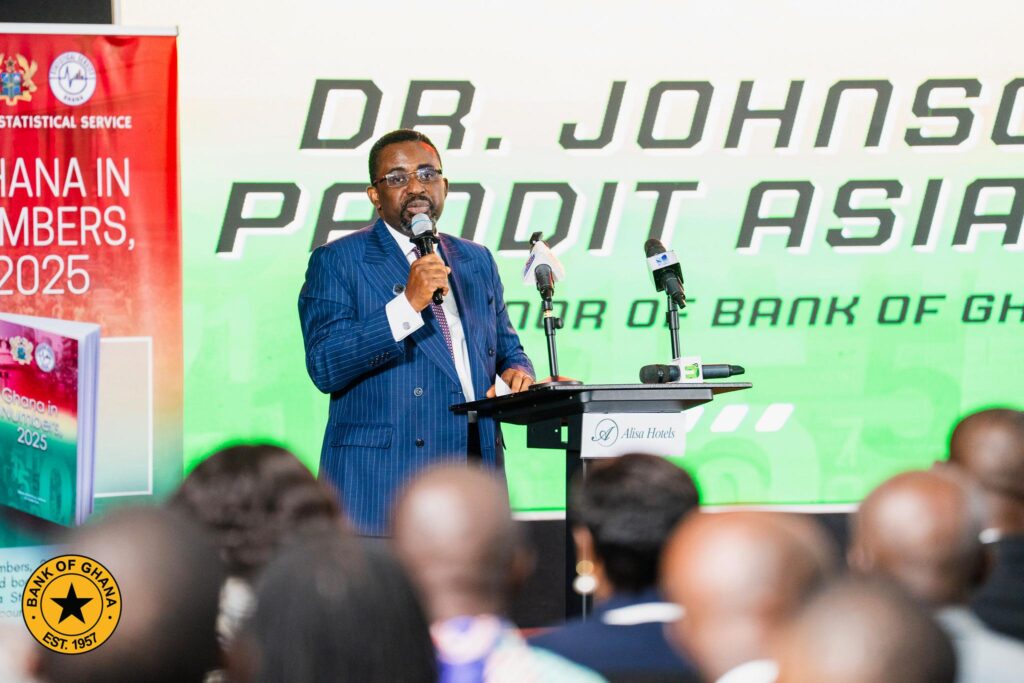
Dr Johnson Pandit Asiama, Governor of the Bank of Ghana (BoG), has advocated for a dedicated digital platform to enhance access to Ghana's official statistics, asserting that improved data accessibility could enhance economic research, policymaking, and investment decisions. At the inaugural Ghana in Numbers 2025, a publication by the Ghana Statistical Service (GSS), Asiama emphasized that making underlying data machine-readable would enable researchers, policymakers, and businesses to utilize artificial intelligence (AI), machine learning, and analytical tools to uncover economic trends and relationships that might not be evident from conventional tables and charts.
He praised the GSS for consolidating vital information on Ghana's socio-economic landscape, describing the report as a crucial resource for grasping national progress, identifying emerging challenges, and establishing development priorities. Asiama highlighted that accurate and timely statistics are crucial for the central bank's monetary policy formulation and financial sector regulation.
As an inflation-targeting central bank, the BoG relies on data to evaluate price movements and their impact on exchange rates, economic activity, credit conditions, and external sector developments. He underscored that dependable economic data not only informs policy but also bolsters transparency, accountability, and public confidence in institutions.
Additionally, he welcomed the inclusion of a dedicated monetary and financial-sector segment in Ghana in Numbers 2025, which heavily relies on official BoG data. This section provides a comprehensive view of the country's economic and financial environment, covering inflation, interest rates, lending patterns, foreign reserves, and banking sector conditions.
Asiama expressed optimism regarding the potential of AI-driven economic analysis, noting that advances in data science, artificial intelligence, and machine learning could augment conventional economic analysis and bolster the central bank's capacity to adapt to shifting economic conditions. However, he emphasized that for these technologies to deliver benefits, data used in publications like Ghana in Numbers must be accessible in electronic formats suitable for analysis.
Asiama proposed a dedicated portal to provide machine-readable datasets, enabling researchers, academics, and policymakers to delve deeper into the information and explore connections between various economic indicators. He also revealed that the BoG is enhancing its data analytics and artificial intelligence capabilities through the establishment of a dedicated department.
Moreover, the central bank is formulating a directive to govern the use of AI in the financial sector, aiming to foster innovation while mitigating the risks associated with the expanding utilization of AI technologies. Asiama's remarks underscored the importance of amalgamating reliable official statistics with cutting-edge analytical tools to fortify economic decision-making while ensuring that the deployment of emerging technologies in the financial sector is appropriately regulated.
Written by urgent.news from MyJoyOnline Ghana's reporting — not their text. Machine-written — may contain errors; check the original before relying on it.