Los accidentes ferroviarios se disparan ante los recortes en el mantenimiento de la red
La inversión del Estado en la infraestructura de la red ferroviaria y su mantenimiento se ha hundido en los últimos años pese a la llegada de cientos de miles de millones de fondos europeos y a la liberalización de la alta velocidad. Leer
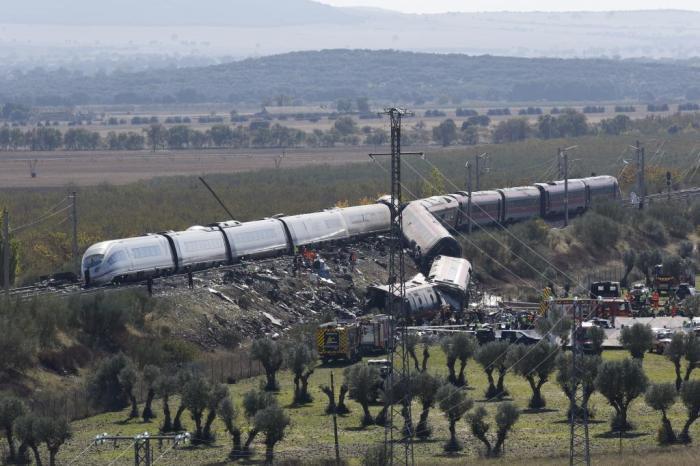
Spanish rail accidents have increased sharply due to reduced maintenance of the network, despite hundreds of millions of euros in European funds and liberalization of high-speed travel. The Spanish rail network, once a European reference in the early 21st century, suffered a new blow on Wednesday after a high-speed train collision in Urda, Toledo, killing over seventy people.
The accident occurred due to a fault in the automatic signaling system LZB, which caused the two trains to collide. Minister of Transport Óscar Puente acknowledged that such incidents are rare but possible. The tragedy in Urda happened just nine months after another high-speed train collision in Adamuz, Córdoba, which left forty-six people dead.
Data from the Guardia Civil attributes the recent tragedies to faulty welds in the tracks, which caused one of the convoys to derail and result in fatal accidents. Over one hundred twenty victims have died in just one year, with the government attributing the incidents to "human error of unimaginable magnitude" or "minimal chances" of recurrence.
The data on investment and maintenance of the Spanish rail network paints a different picture. Since Prime Minister Pedro Sánchez took office in 2018, and until 2024, rail accidents have increased by 142%, making the national network the one with the highest mortality rate in Europe. The number of derailments has also grown by over 300% in the same period, rising from just seven in 2009 to 22 in 2024.
The first major rail crisis in the Sánchez government occurred in 2023, following the liberalization of the high-speed network and the entry of French company Ouigo and Italian Iryo in mid-2021. This increased the use of the network for over 100,000 annual journeys, according to data from the National Commission of Markets and Competition (CNMC).
Since then, the number of delays in long-distance trains has multiplied by seven. However, instead of increasing investment in infrastructure, the government reduced compensation for passengers and allocated more funds to subsidize Renfe tickets (1.371 million euros) than to maintain the tracks (1.100 million euros), as reported by the Instituto Juan de Mariana.
The continuous issues in the network, combined with the two recent catastrophes in Adamuz and Urda, threaten to bring down the passenger rail transport sector, which has been experiencing a declining trend in 2026 despite a record tourism season. Data from the National Statistics Institute shows a 5.3% drop in the number of travelers in the second quarter of 2026, after a 12% decline in the first quarter following the Adamuz accident, even falling below the 2024 figure.
The decline in investment and maintenance of the Spanish rail network began before Sánchez's arrival. Since its peak in 2009, when the state spent 240 euros per capita per year, investment has fallen by 68.75%, reaching 75 euros per capita in 2024, according to data from the BBVA Foundation and IEV. Of this total expenditure, the government allocated only 15.8% to maintain the rail network, a significantly lower percentage compared to other major EU economies like the Netherlands (29.1%), Italy (25.9%), Belgium (22.8%), and France (19.1%).
This places Spain as the third worst EU member state in this area, with a spending of 45.5 million euros on network conservation per every 1,000 kilometers, compared to the EU average of 80.6 million euros, as estimated by the Institute of Economic Studies (IEE).
Written by urgent.news from Expansion ES's reporting — not their text. Machine-written — may contain errors; check the original before relying on it.