Examining the Cat's Head Nebula with the Hubble and JWST
Star formation is a complicated process. It involves metallicity, gas temperature and density, dust grains, and stellar feedback from existing stars. Sometimes, studying all these factors and how they work means studying some of Nature's most beautiful structures, like the Cat's Head nebula in the Carina Nebula.
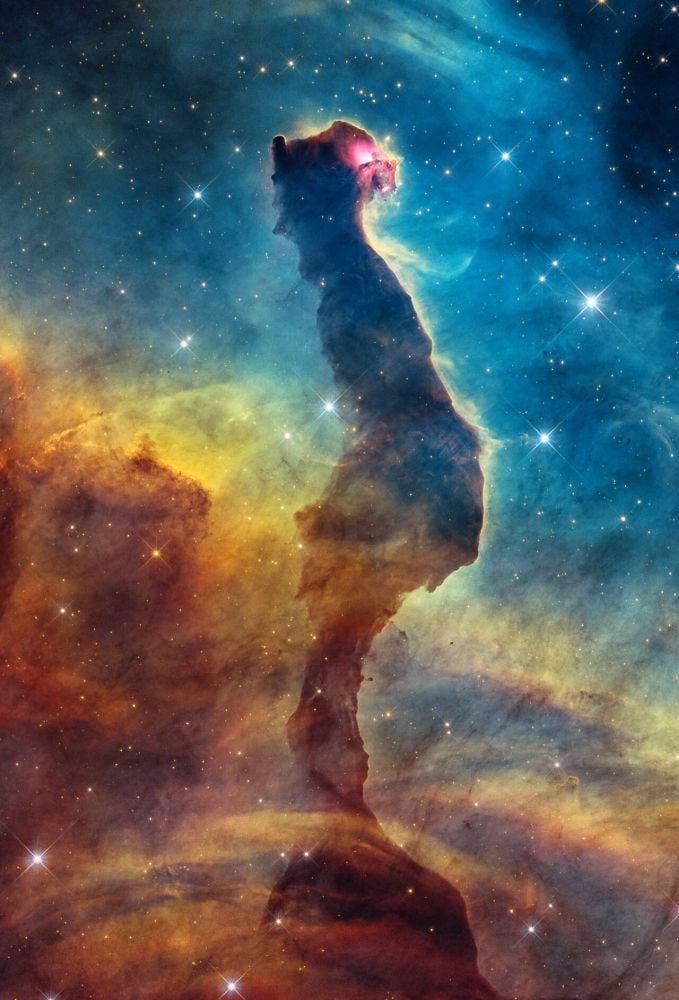
The Cat's Head nebula earns its unusual name from its appearance, resembling a feline creature gazing towards the cosmos with a glowing eye. This intricate structure, a fragment of the expansive Carina Nebula, resides approximately 7,500 light years from Earth. Scientists from both the Hubble and JWST space telescopes have focused their lenses on this captivating nebula to unravel the mysteries of star formation, a perpetual focus of astronomical research.
The Carina Nebula is a breeding ground for colossal stars, with the Carina OB1 association housing some of the most massive stars in the Milky Way. Among these luminous stars is Eta Carinae, a stellar system that boasts a combined luminosity surpassing 5 million times that of the Sun. This luminous entity is also the driving force behind the Homunculus Nebula, an enigmatic entity hidden from view in the present imagery.
Hubble's depiction of the Cat's Head nebula is in visible light, while the JWST captured its essence in both near and mid-infrared spectra. Each image reveals distinct facets of the nebula. The prominent pillar, a dark expanse of dust, stands resilient against the onslaught of stellar wind and radiation from the colossal stars. The yellowish outline on its right side is indicative of photoevaporation, a process fueled by the same powerful stars. Ultraviolet radiation ionizes the gas on the rim, gradually eroding it away.
The colors in these astronomical images are derived from various filters, each isolating specific chemicals such as sulphur, oxygen, and hydrogen. The ionization levels of these elements, their energy states, and the amount of dust present all contribute to the colors observed. Despite the lack of precise chemical identification, these visuals remain breathtaking. The stellar winds and radiation from these massive stars also give rise to the arcs and shoals in the images.
Zooming into a specific portion of Hubble's image highlights the "eyeball," presumably a star situated in an opportune position. The JWST, an infrared telescope, provides an entirely different, albeit equally mesmerizing, perspective on the Cat's Head nebula. This ethereal allure is further accentuated by the JWST, which unveils background stars and galaxies, a pastel-colored gas cloud punctuated with stars, and a potentially nascent star nestled amidst thick dust to the right of the head.
The mid-infrared image of the Cat's Head nebula by the JWST presents a muted, ghostly white appearance, enveloped by pastel gas clouds adorned with stars. Carbon molecules and warm dust emissions steal the spotlight in this image. An infant star is discernible in this image, concealed within a thick veil of dust, just to the right of the head.
The white haze of the gas in this mid-infrared image bears a striking resemblance to earthly clouds. The gas to the left reveals finer details, while the blackness of space is subtly visible in the upper right and upper left corners. Ultimately, these images serve a crucial scientific purpose, enabling astronomers to discern stars, dust, gas, and chemical compositions, thereby shedding light on the intricate processes of stellar feedback and its impact on star formation.
Written by urgent.news from Universe Today's reporting — not their text. Machine-written — may contain errors; check the original before relying on it.