Astronomers Discover a Possible New Dwarf Planet in Our Solar System
Lying beyond Pluto, 2026 ED138 could be as large as 1,500 kilometers in diameter. Astronomers are still working to confirm whether it meets the criteria for a dwarf planet.
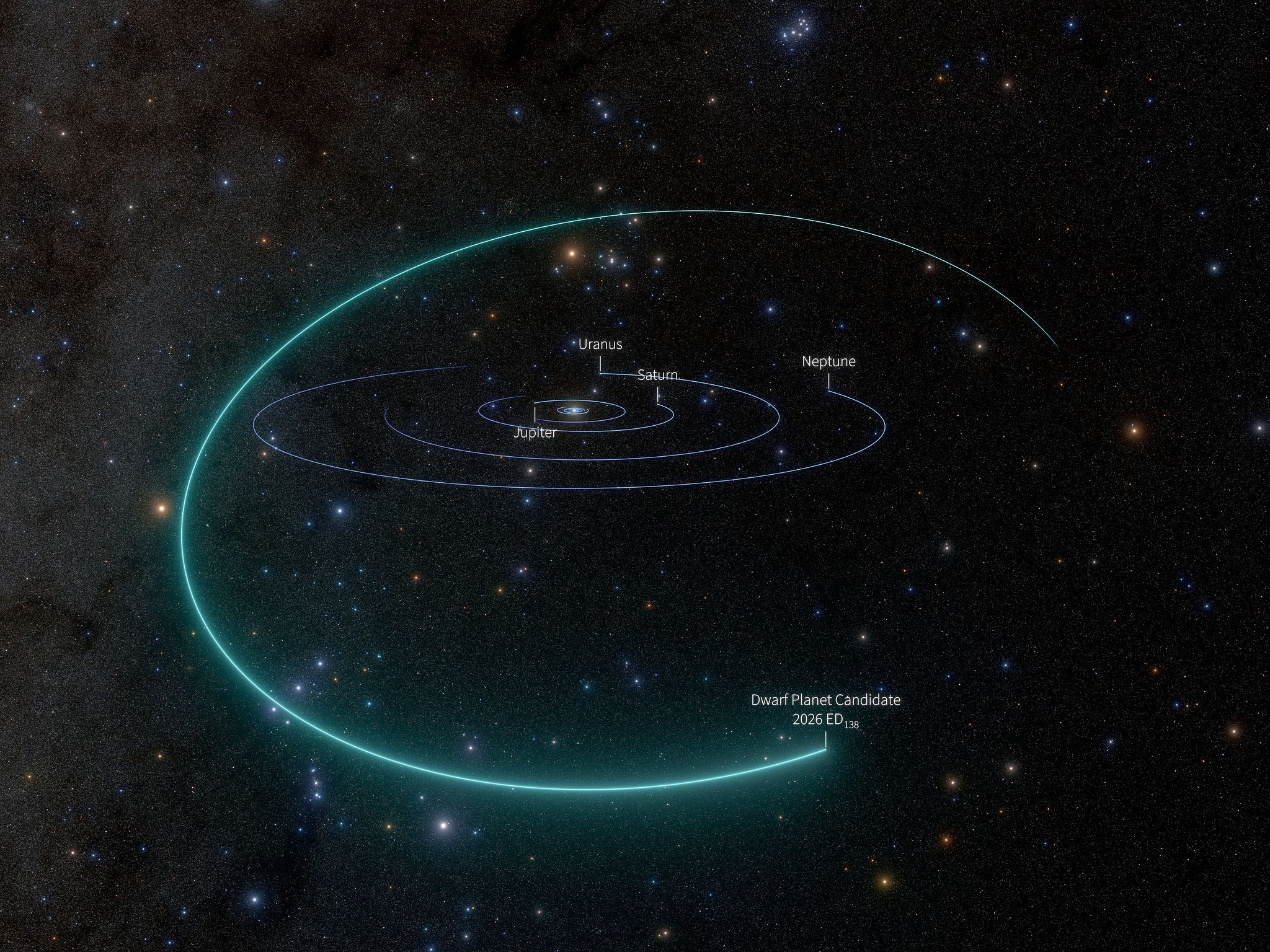
Astronomers have discovered a possible new dwarf planet in our solar system named ED138. The prospective planet, measuring between 600 and 1,500 kilometers in diameter, orbits approximately 46 astronomical units from the sun, slightly beyond Pluto's average distance of 40 astronomical units. Although ED138 resembles other dwarf planets, such as Pluto, Ceres, Haumea, Makemake, and Eris, it has not yet been confirmed as one because its size and mass need further verification.
Its discovery was made against the backdrop of the Milky Way's bright disk, making it challenging to spot. Nonetheless, the immense data provided by the Rubin Observatory helped identify ED138 among countless other celestial objects. If confirmed, ED138 would join the esteemed group of five recognized dwarf planets.
Written by urgent.news from Wired's reporting — not their text. Machine-written — may contain errors; check the original before relying on it.
This story
This is one outlet's version. Read the fullest account.
- Icy Object Spotted Beyond Pluto Emerges as New Dwarf Planet Candidate in the Solar System's Outskirts discovermagazine.com
- Astronomers Discover a Possible New Dwarf Planet in Our Solar System wired.com
- Rubin Observatory reveals its first dwarf planet candidate in our solar system phys.org
- The Rubin Observatory Finds Its First Dwarf Planet Candidate universetoday.com
- New Vera C. Rubin telescope spots possible new dwarf planet beyond Pluto cbc.ca
- The Vera C. Rubin Observatory may have just discovered our solar system’s sixth dwarf planet scientificamerican.com