Astronomers Discover a Possible New Dwarf Planet in Our Solar System
Lying beyond Pluto, 2026 ED138 could be as large as 1,500 kilometers in diameter. Astronomers are still working to confirm whether it meets the criteria for a dwarf planet.
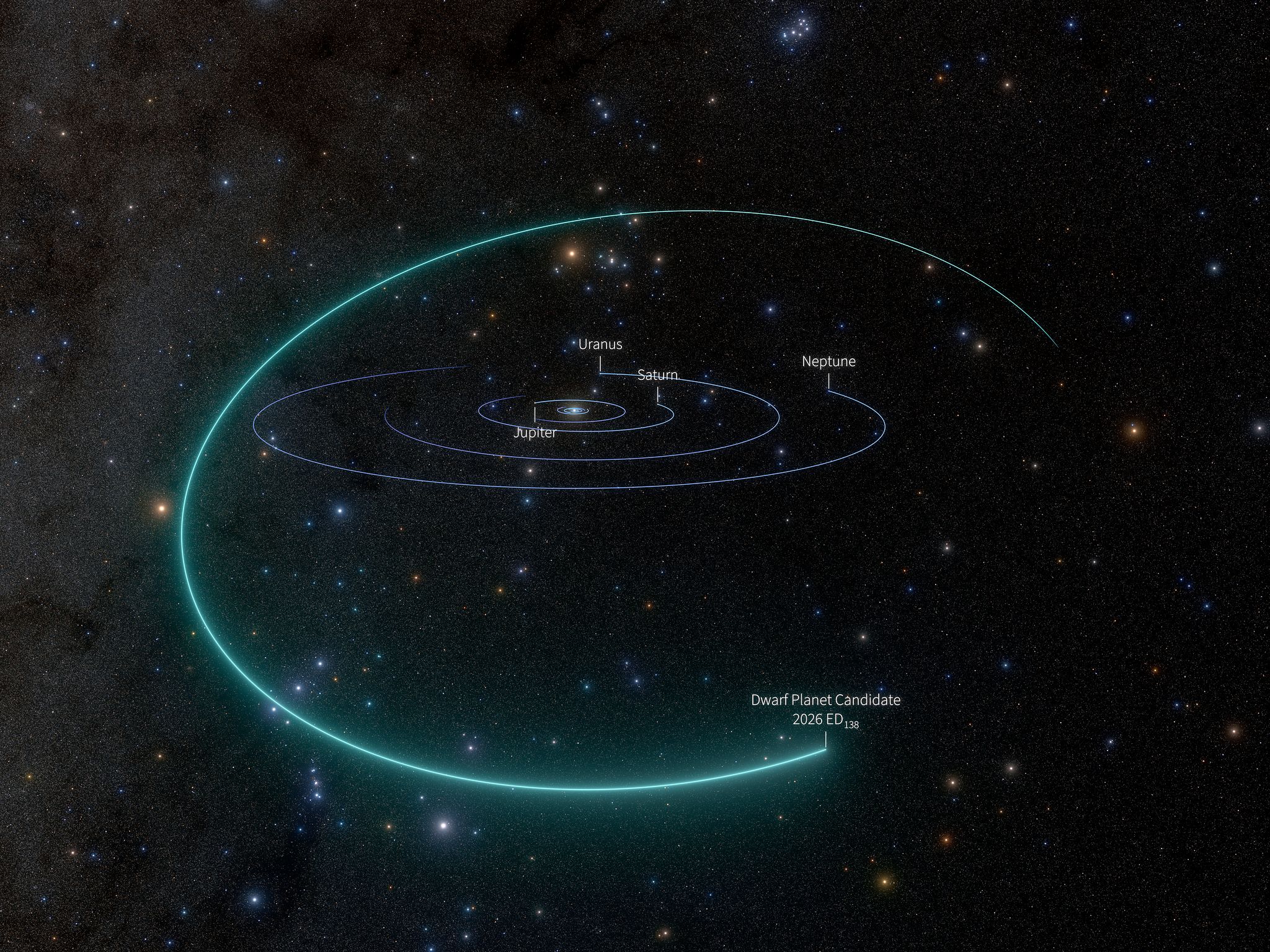
Scientists have recently identified a potential new dwarf planet in our solar system, named ED138. This celestial body is estimated to have a diameter ranging from 600 to 1,500 kilometers and orbits the sun at an average distance of 46 astronomical units. To put this into perspective, Pluto, another dwarf planet, resides at an average distance of 40 astronomical units from our star.
Based on its location, ED138 is classified as a trans-Neptunian object, sharing the same category as Pluto. The distinction between a planet and a dwarf planet lies in their environments. Both orbit the sun and possess enough gravity to assume a nearly spherical shape, but a planet has cleared its orbit of other bodies of comparable size, while a dwarf planet coexists with other objects in the region it traverses.
This explains why Pluto was reclassified as a dwarf planet in 2006. Matthew Holman, an astronomer at the Harvard-Smithsonian Center for Astrophysics, discovered ED138 on October 13 while analyzing data collected by the Rubin Observatory in 2026. Further examination of archived records dating back to 2016 confirmed the object's trajectory over the past decade.
ED138 managed to remain hidden from view due to its position against the Milky Way's disk, which is typically visible as a thick band of millions of stars. The Rubin Observatory's vast data collection enabled astronomers to spot the object amidst this cosmic backdrop. However, confirming ED138's dwarf planet status requires more precise measurements of its size.
Currently, scientists know it is a trans-Neptunian object, but determining its gravitational force, which determines its shape, is still pending. If confirmed, ED138 would join the five recognized dwarf planets: Ceres, Pluto, Haumea, Makemake, and Eris. ED138 is not the only celestial body awaiting classification. Astronomers have identified dozens of objects in the outer solar system that could meet the criteria, including Gonggong, Quaoar, Sedna, and Orcus.
Confirming these as dwarf planets is a challenging task due to their immense distances, making it difficult to measure their size and mass accurately and to ascertain if their own gravity has given them a nearly spherical shape. The solar system is far more extensive than commonly depicted, consisting of planets, moons, dwarf planets, asteroids, comets, and countless small bodies.
The Kuiper Belt, extending up to approximately 50 astronomical units, and the scattered disk, reaching nearly 1,000, harbor numerous objects. Beyond Neptune lies the Oort Cloud, a region never directly observed and potentially extending up to 100,000 astronomical units from the sun.
Written by urgent.news from Wired Science's reporting — not their text. Machine-written — may contain errors; check the original before relying on it.
This story
This is one outlet's version. Read the fullest account.
- Icy Object Spotted Beyond Pluto Emerges as New Dwarf Planet Candidate in the Solar System's Outskirts discovermagazine.com
- Astronomers Discover a Possible New Dwarf Planet in Our Solar System wired.com
- Rubin Observatory reveals its first dwarf planet candidate in our solar system phys.org
- The Rubin Observatory Finds Its First Dwarf Planet Candidate universetoday.com
- New Vera C. Rubin telescope spots possible new dwarf planet beyond Pluto cbc.ca
- The Vera C. Rubin Observatory may have just discovered our solar system’s sixth dwarf planet scientificamerican.com