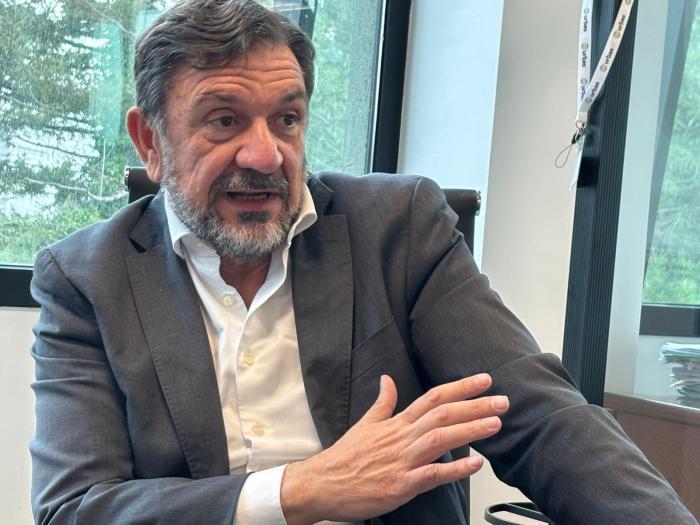
Adif y Renfe "necesitan despolitizar y profesionalizar la gestión"
Antiguos administradores de empresas y exaltos cargos del Ministerio de Transportes creen que la alta velocidad es un acierto y logro de España que hay que profesionalizar. Leer
Former business administrators and former high-ranking officials from the Ministry of Transport believe that high-speed rail is a success and achievement of Spain that needs to be professionalized. The serious management and reputation crisis currently facing Spanish railroads, following two tragic accidents this year that have claimed at least 115 lives, has put high-speed rail in the spotlight with broken trust and growing doubts about its sustainability under current management conditions.
With two state-owned companies, Renfe and Adif, particularly affected by decisions from the Ministry of Transport, one of the biggest political weapons in the government's hands. EXPANSIÓN reached out to five of the most authoritative voices in Spain in the field of mobility who have personally worked on shaping and developing the current railway model.
Víctor Bañares, founder of Iryo, a competitor of Renfe in high-speed rail; Julio Gómez-Pomar, former Secretary of State for Infrastructure; Juan Alfaro, former president of Renfe; and Berta Barrero, former General Director of Operations for Renfe and former director of Ineco, all defend high-speed rail, propose short and medium-term solutions, analyze the future of Adif and Renfe and propose solutions to detach railway management from political interference that hinders the execution of long-term strategies.
In contrast to those who question the development of high-speed rail after the serious accidents, the four experts vehemently defend the Spanish model, which has opted for liberalization. "Both Renfe, Iryo and Ouigo, are operationally exemplary; the failure is in not having separated political power from corporate governance and management for many years," says Víctor Bañares, founder and former CEO of Iryo.
Julio Gómez-Pomar, who chaired Renfe a few years before losing his monopoly status, says high-speed rail "has allowed us to create a cluster of companies around railroads that operate worldwide, but it is very demanding in terms of human and material resources, and maintaining this standard requires a very high commitment from all governments."
Juan Alfaro, former president of Renfe, sees high-speed rail as "a success in terms of connecting the territory and projecting the Spanish brand." He believes the origin of the crisis is forgetting that high-speed rail needs a stable planning and governance model, including construction, management, maintenance, and conservation as major axes of action.
Berta Barrero, who was General Director of Operations for Renfe and a high-ranking official at Ineco, stresses that "the debate should not focus on questioning the model, but rather reflect on how we have accompanied the development of our infrastructures with planning, management, operation, and maintenance models capable of evolving at the same pace as the infrastructures and the mobility needs of our society."
According to the directive, now at Eysa, liberalization requires adequate planning of infrastructure capacity, maintenance needs, and financing models to ensure the sustainability of the entire system. Restoring trust in rail requires immediate measures focused on safety and technological maturity. Barrero identifies three priority areas of action: "Railway system governance, strengthening the safety culture, and proper planning of the maintenance and renewal of infrastructures."
User distrust is "more than reasonable," according to Gómez-Pomar, who proposes placing transportation system safety as the first and most important objective, and increasing economic effort in maintenance through rigorous protocols and meticulous supervision. Juan Alfaro, now a partner at consultancy Inframove, warns that the short-term solution lies in changing the governance model and reordering investment priorities under a clear hierarchy: "First, safety; second, user benefit; third, increasing capacity; fourth, thinking about the lifecycle."
Víctor Bañares, a leading voice in the mobility world having been part of the founding team of Vueling, calls for public recognition of technical experts in politics and proposes a legislative reform package, tentatively named "Law 115 in memory of the victims," to guarantee the sustainability of Renfe and Adif as leading companies admired.
The four experts agree on how to ensure the sustainability of Renfe and Adif as reference companies. Bañares defends a clear separation between public and commercial services. He urges to immediately remove Adif, AENA, and Renfe's commercial services from Transport Ministry oversight and "immediately transfer the corporate governance bodies of the aforementioned companies to Sepi."
At the same time, he demands a "cultural change among public company executives so large that it completely renews these teams" to replace them with highly competent professionals. Alfaro, who previously worked at various levels of government and the public sector, agrees that both companies must gain real autonomy and "completely independent from political winds" by moving to "depend on another ministry or even other public bodies such as Sepi" to guarantee greater distance from the regulatory ministry in a liberalized market.
Written by urgent.news from Expansion ES's reporting — not their text. Machine-written — may contain errors; check the original before relying on it.