Three-Photon Microscopy Reveals Neural Activity Deep in the Mouse Brain
By optimizing laser, optical, and acquisition parameters, The Rockefeller University researchers developed a three-photon microscopy platform that captures deep-brain neural activity in living mice at single-cell resolution without surgically removing the overlying cortex. The post Three-Photon Microscopy Reveals Neural Activity Deep in the Mouse Brain appeared first on GEN - Genetic Engineering…
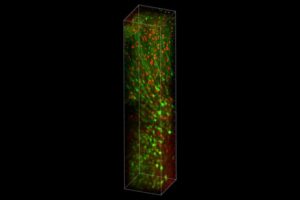
Researchers at The Rockefeller University have improved a three-photon microscopy technique called Three-photon Ultra-Deep Imaging (TrUDI) to record neuronal activity deep within the brain without removing overlying tissue. Led by Alipasha Vaziri, PhD, head of Rockefeller’s Laboratory of Neurotechnology and Biophysics, the team developed TrUDI to surpass previous limitations in imaging depth and clarity.
TrUDI generates approximately 250 times more detected fluorescence photons at the same laser power as prior methods, allowing single-cell-resolution recordings of neuronal population activity at depths of around 2 mm. By taking a fresh approach to laser and optics parameters, the researchers achieved safer and more effective imaging.
Previous three-photon functional recordings had reached about 1.2 mm, just shy of the technique's theoretical depth limit of over 2 mm. By optimizing the laser, optics, and acquisition settings according to linear and nonlinear limits, TrUDI safely exposed tissues while maintaining single-cell resolution in calcium imaging. The platform was successfully tested in mice, enabling recordings over fields of view about 230 by 230 µm 2 at a rate of 8.6 Hz, reaching close to 2 mm into the cortex and hippocampus.
While the new technology expands access to deep brain circuits previously requiring tissue removal for optical imaging, it does not render every deep structure directly accessible. Some areas, like certain striatal regions, remain off-limits due to their depth, and some deep brain nuclei still demand invasive techniques. Nonetheless, TrUDI showcases how optimizing the technology can push three-photon imaging closer to its depth potential while preserving the tissue above the studied areas.
Written by urgent.news from GEN Biotechnology's reporting — not their text. Machine-written — may contain errors; check the original before relying on it.