Eradicating invasive bass gives endangered South African fish room to recover
An ambitious effort to eradicate invasive spotted bass from South Africa’s Breekkrans River has unfolded about two hours north of Cape Town. Removing the bass has helped give the critically endangered doring fiery redfin (Pseudobarbus doring) a fighting chance against extinction. “Spotted bass were introduced into the river system in the late 1930s,” Martine Jordaan, […]
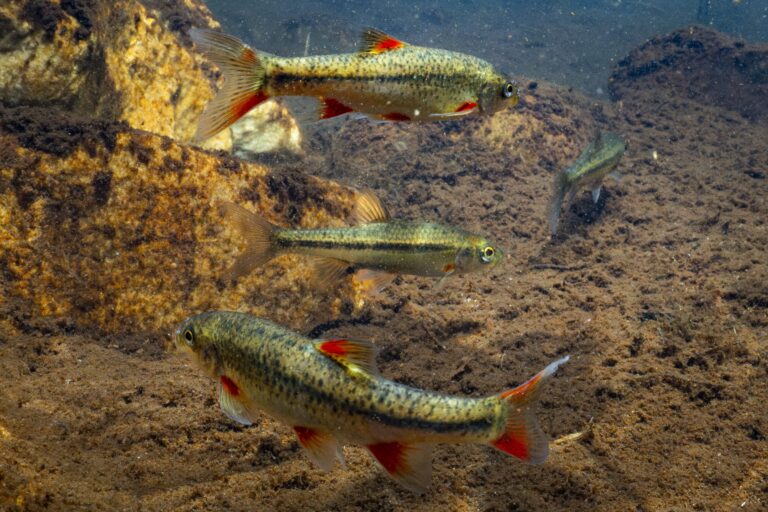
In a bid to save a critically endangered fish species, an ambitious project to eradicate invasive spotted bass from South Africa's Breekkrans River is underway. The eradication efforts, carried out by the Freshwater Research Centre (FRC), have given the fiery redfin (Pseudobarbus doring) a better chance of survival against extinction.
Martine Jordaan, a faunal ecologist at Cape Nature, explained that spotted bass were introduced into the river system in the late 1930s as a species suitable for angling. However, her research showed that spotted bass are particularly aggressive when it comes to preying on small fish, which are the primary food sources for native fish species in the region.
The invasive bass species spread rapidly through the river system, only stopping when it encountered natural barriers such as waterfalls. This allowed the spotted bass to thrive in most areas of the river, leading to the decline and restricted habitat of native fish populations. The fiery redfin, in particular, was found to predominantly inhabit streams where the bass could not reach.
Jeremy Shelton, a freshwater conservation ecologist at FRC, confirmed that the Breekkrans River currently has the largest remaining population of fiery redfin, with approximately a few hundred adult fish. This species also exists in another river, but in significantly smaller numbers. Prior to the eradication of the spotted bass, the fiery redfin were limited to a 2-kilometer (1.2-mile) stretch of the Breekkrans River that remained free of bass.
The Breekkrans River Restoration Project, managed by FRC, aims to restore the natural balance of the river ecosystem by removing the invasive bass species. This allows the critically endangered fiery redfin to once again thrive and recover in its native habitat.
Written by urgent.news from Mongabay's reporting — not their text. Machine-written — may contain errors; check the original before relying on it.