Too late, too far, too little choice: Why surplus food apps face challenges matching meals with takers
"They all want merchants near their home, near the office, and at a very steep discount and at a very convenient timing," says the founder of a food rescue app.
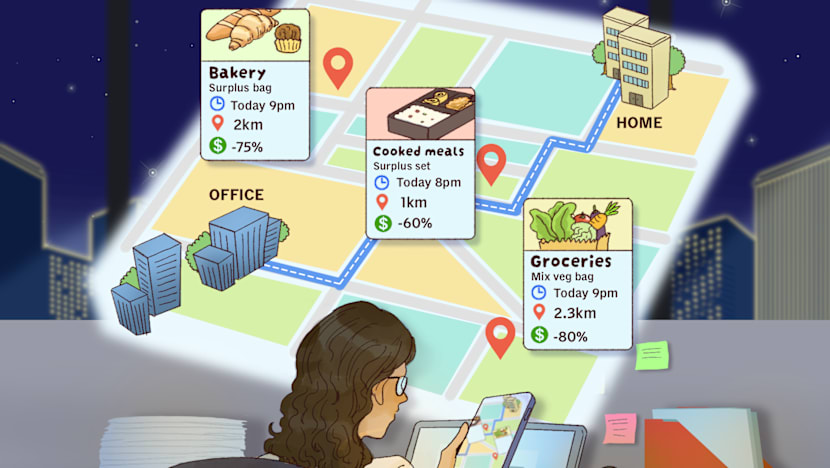
Food waste is a growing concern in Singapore, with an average of 128kg of food waste generated per person annually in 2025. To address this issue, the government introduced a motion calling for efforts to reduce food waste and improve food resilience. Food rescue apps have emerged as a solution, allowing businesses to sell discounted surplus food to consumers. However, these apps face several challenges in matching meals with takers.
One of the main challenges is the mismatch between the demand and supply of food, considering factors such as location, timing, and distance. Users prefer merchants near their homes or offices, at a steep discount, and at a convenient time. For instance, an app user reported that a meal could have been available for dinner but was only available at 8pm, which was too late. Similarly, a bundle of bread that could have been saved for breakfast was available, but the bakery was more than a kilometre away.
Another challenge is the limited reach of food rescue apps. In the early days of FoodToo, a later entrant to the surplus food redistribution scene, the app struggled to gain traction due to its limited user base and merchants. The founder, Kelvin Yap, noted that users were unwilling to travel far for food available later in the day. The app required integration with merchants' systems and workflows, which proved to be a hurdle in onboarding larger chain outlets and franchises.
While some food rescue apps have achieved scale, such as Yindii, they also face challenges in matching supply with demand. Yindii has around 250,000 users and 400,000 users by September 2025, with 60% of users placing repeat orders. However, the better locations for food pick-up are near MRT stations, while secluded areas require users to have a car, resulting in lower sell-out rates.
Professor Adrian Kuah from James Cook University highlighted convenience, scale, and network density as key challenges faced by these platforms.
While consumers support reducing food waste, they may still be unwilling to travel far, accept inconvenient collection times, tolerate uncertain product availability, or purchase food perceived as less fresh. The consumer convenience factors, particularly location, collection time, choice, and perceived food quality, are crucial determinants of consumer demand for these apps.
Written by urgent.news from CNA - Singapore's reporting — not their text. Machine-written — may contain errors; check the original before relying on it.
This story
This is one outlet's version. Read the fullest account.