Too late, too far, too little choice: Why surplus food apps face challenges matching meals with takers
"They all want merchants near their home, near the office, and at a very steep discount and at a very convenient timing," says the founder of a food rescue app.
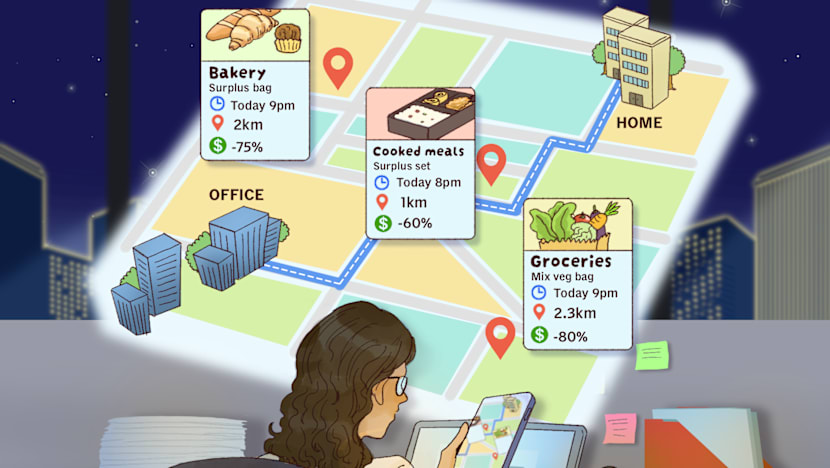
Food waste remains a pressing issue in Singapore, with the country generating 790,000 tonnes of total food waste per year, or about 128kg per person annually. To address this problem, food rescue apps have emerged, allowing businesses to sell surplus food at discounted prices to consumers. However, these apps face significant challenges in matching meals with takers due to factors such as location, timing, and convenience.
Founders of food rescue apps emphasize the importance of merchants being near their customers' homes or offices, offering deep discounts, and having flexible timing options. For example, a meal might be available for pickup after 9 pm, but users may not be willing to travel far for it. Similarly, a bundle of bread that could have been saved for breakfast the next day might be available only more than a kilometre away from the user.
Platforms like Yindii and Treatsure have gained traction in Singapore, with Yindii reporting around 250,000 users by the end of 2025 and Treatsure experiencing growing uptake rates. However, these apps still struggle to achieve sufficient scale and network density, as they require a large number of merchants and consumers to generate sufficient transaction volume.
The need for convenience, such as being near an MRT station and having a short travel distance, plays a crucial role in consumer demand. Even though Singapore has high population density that supports efficient transportation, the domestic market remains small, placing substantial reliance on merchant and consumer participation.
Prof Kuah, a Professor of Strategy and Sustainability at James Cook University, highlights that consumer convenience, including location, collection time, choice, and perceived food quality, is a significant determinant of consumer demand.
Written by urgent.news from Channel News Asia's reporting — not their text. Machine-written — may contain errors; check the original before relying on it.