Handel: Steinmeiers Botschaft in China: „Ich rate, dass wir unser Licht nicht unter den Scheffel stellen“
In Hefei wirbt der Bundespräsident für Kooperation, während Chinas Handelsüberschuss neue Rekorde erreicht. Doch Steinmeier verlangt auch mehr Selbstbewusstsein gegenüber Peking.
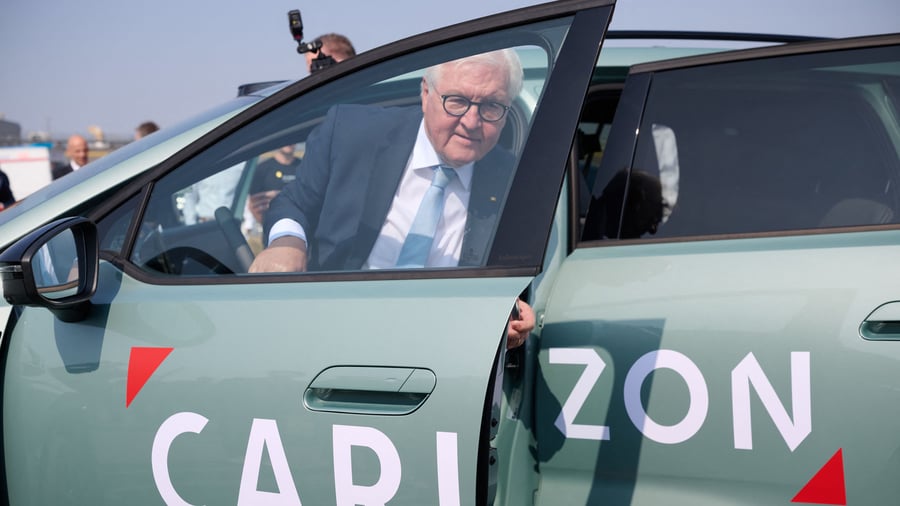
Frank-Walter Steinmeier has been advocating for close cooperation between Germany and China for decades. As Foreign Minister, he warned against "panic" in 2007 over China's rise, and in 2008 he warned against a new political bloc formation in Chongqing. During his last China trip as Federal President in Hefei, he warned against black-and-white thinking.
However, Germany has been discussing the "China Shock 2.0": the country's trade surplus with China grew to $938 billion in the first nine months of 2026, with $133.5 billion alone in September. Chinese exports to Germany increased by 31.4% in September, while imports from Germany rose by only 0.1%. Steinmeier, accompanied by his wife Elke Büdenbender, visited Hefei, the capital of Anhui province, to discuss responses to the new reality.
The city is an emerging tech metropolis and a hope for worried German business representatives. During a visit to Luogang Park, a former airport, Steinmeier spoke about successful German-Chinese cooperations, but also expressed caution about the growing trade imbalance, urging Germany to continue the model for mutual benefit. Volkswagen is cooperating with Chinese startups in Hefei, with the goal of using the insights globally.
They see potential in China's development speed and innovation. However, critics point to the trade surplus as the main reason for job losses, particularly in German industries like automobiles and machinery. Steinmeier's message combined the need for dialogue and cooperation with the warning not to hide Germany's light under a bushel.
He called for self-confidence in how Germany presents itself to China – two demands that can be contradictory. The trip comes at a time when the European-China cooperation model is under pressure. Chinese manufacturers are gaining ground in the German market, especially in electric cars. Steinmeier cited a recent agreement between EU Trade Commissioner Maros Šefčovič and China's Trade Minister Wang Wentao, which aims to significantly reduce China's exports of hybrid and plug-in hybrid vehicles to Europe in the coming years.
However, the agreement does not specify a concrete figure. The visit coincides with a time when the European-Chinese cooperation model is under pressure. Chinese manufacturers are gaining ground in the German market, particularly in electric cars. Meanwhile, Steinmeier can point to a partial success achieved in Brussels: EU Trade Commissioner Maros Šefčovič reached an agreement with China's Trade Minister Wang Wentao a few weeks ago, aiming to significantly reduce China's exports of hybrid and plug-in hybrid vehicles to Europe in the coming years.
The joint declaration of the EU and China calls for no specific number. Steinmeier described the agreement as a "good start" that could also bring hope for other industries. The Federal President held a phone conversation with Šefčovič before the trip. The state visit is the first by a German Federal President to China since 2018.
It is notable that this interaction is not new – in 2022, Steinmeier visited Japan and South Korea, while Chancellor Olaf Scholz visited Beijing during the same period. In Beijing, Steinmeier will meet with Chinese President Xi Jinping, Premier Li Qiang, and the Chairman of the National People's Congress, Zhao Leji. On Thursday, he will give a speech at Peking University.
The former Foreign Minister and long-standing Federal President is seen as one of the few German politicians in China with whom dialogue has been consistent for decades. After two terms, Steinmeier will step down from office in March 2027. The Bundestag will elect his successor on January 30, 2027. The debate over his successor is already underway.
Steinmeier's trip to China, spanning Hefei's picturesque Huangshan mountains and Beijing, is seen by some in his delegation as giving in to Chinese demands. However, it is also seen as a concession from the German side, aimed at systemic economic and trade issues. Economic associations, such as the BDI, have economic representatives accompanying Steinmeier, including Katarina Barley (SPD), Omid Nouripour (Green), Hubertus Heil (SPD), and Johannes Volkmann (CDU).
Written by urgent.news from Handelsblatt's reporting — not their text. Machine-written — may contain errors; check the original before relying on it.
This story
This is one outlet's version. Read the fullest account.
- Leapmotor: "We're not simply assembling parts that come from China" handelsblatt.com