Witness the birth of a star in the latest James Webb Space Telescope photo of the month
NASA/ESA have released their favorite image snapped by the James Webb Space Telescope in October, which depicts a “turbulent” stellar nursery
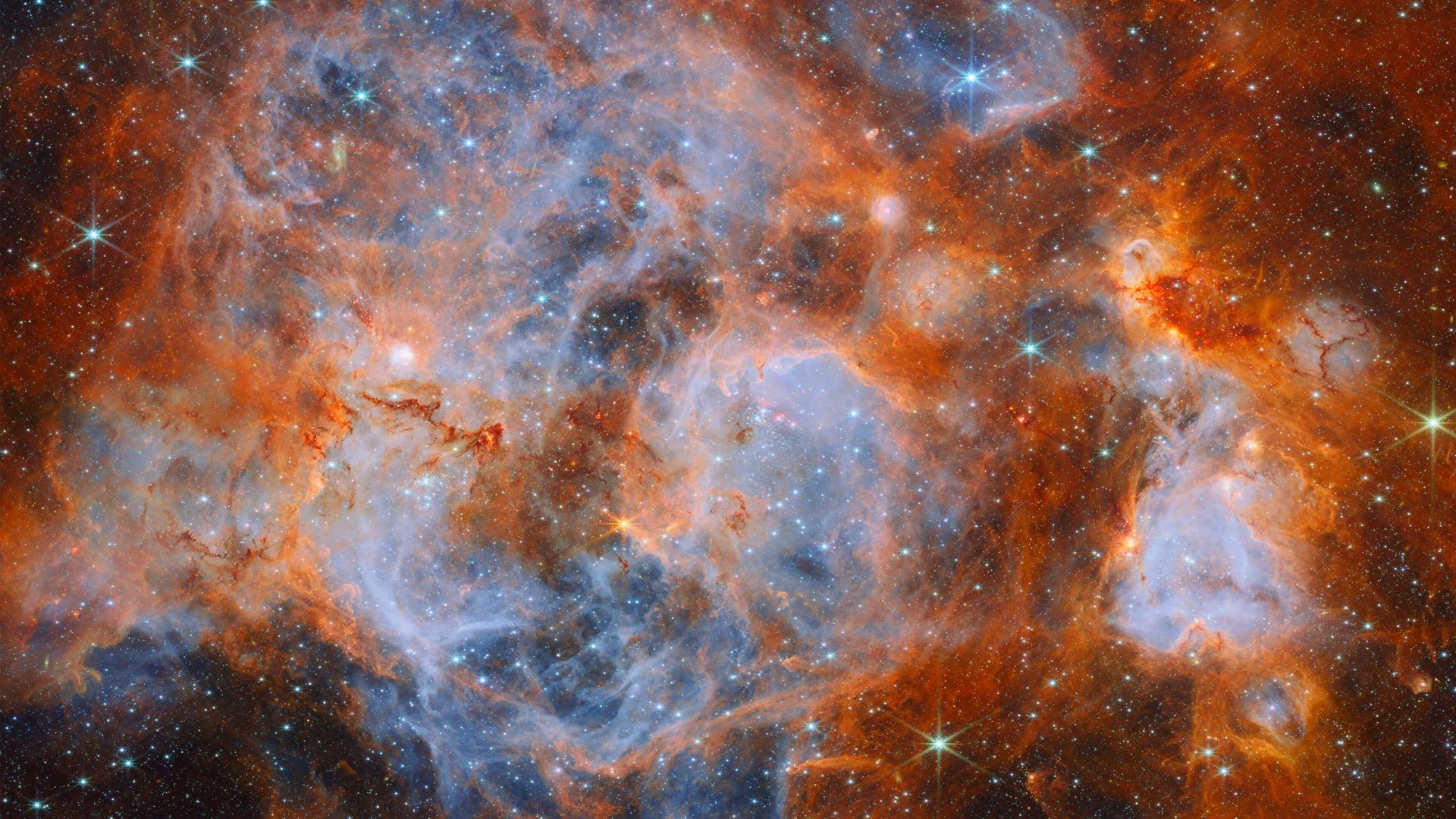
NASA and the European Space Agency (ESA) have unveiled a stunning image from the James Webb Space Telescope (Webb), showcasing a turbulent stellar nursery. Every month, NASA and the ESA select their favorite Webb image from the past four weeks to share with the public. This month's featured photo, captured by Webb, reveals a star-forming region known as LHA 120-N 159, or N159, located 161,000 light-years away in the Large Magellanic Cloud (LMC), a satellite galaxy orbiting our own Milky Way galaxy.
N159 is classified as an H II region, an area filled with ionized hydrogen gas. Astonomers explain that within such regions, massive clouds of cold hydrogen gas collapse under gravity, birthing new stars. Some of these stars are incredibly massive and hot. The image reveals a star-forming region shrouded by thick orange clouds, with the orange hue indicating light emitted by polycyclic aromatic hydrocarbons, a carbon-based molecule.
The image's age is estimated at around three million years, making N159 one of the youngest star-forming regions in the LMC. It contains thousands of stars at varying stages of formation. Pale blue clouds are scattered throughout the image, consisting of ionized H II gas, which has been energized by intense ultraviolet light emitted from massive stars.
The dark red filaments spanning the center of the image are made of cooler molecular hydrogen, serving as the densest part of the nebula and shielding young stars from harmful radiation and stellar winds.
To capture this 230-light-year-wide image, astronomers utilized Webb's Near-Infrared Camera (NIRCam), the primary imaging instrument aboard the telescope. NIRCam can detect light spanning from 0.6 micrometers (visible red light) to 5 micrometers (near-infrared). Since infrared light can penetrate dense cosmic dust clouds that block normal visible light, NIRCam enabled scientists to peer deep into N159.
They have since published a paper on the observation, highlighting how the conditions within this stellar nursery, believed to mirror those of the early universe, have enhanced our understanding of star formation during that epoch.
Written by urgent.news from Digital Camera World's reporting — not their text. Machine-written — may contain errors; check the original before relying on it.