NASA SEES Interns Tackle Real-World Challenges in Lunar Exploration
The NASA STEM (Science, Technology, Engineering, and Mathematics) Enhancement in Earth Science (SEES) Internship Program at the University of Texas Center for Space Research places high school students on small, mission-focused research teams mentored by NASA, academic, and industry experts. During summer 2026, the SEES Mission Architecture Tool for Research, Integration, and eXploration (MATRIX)…
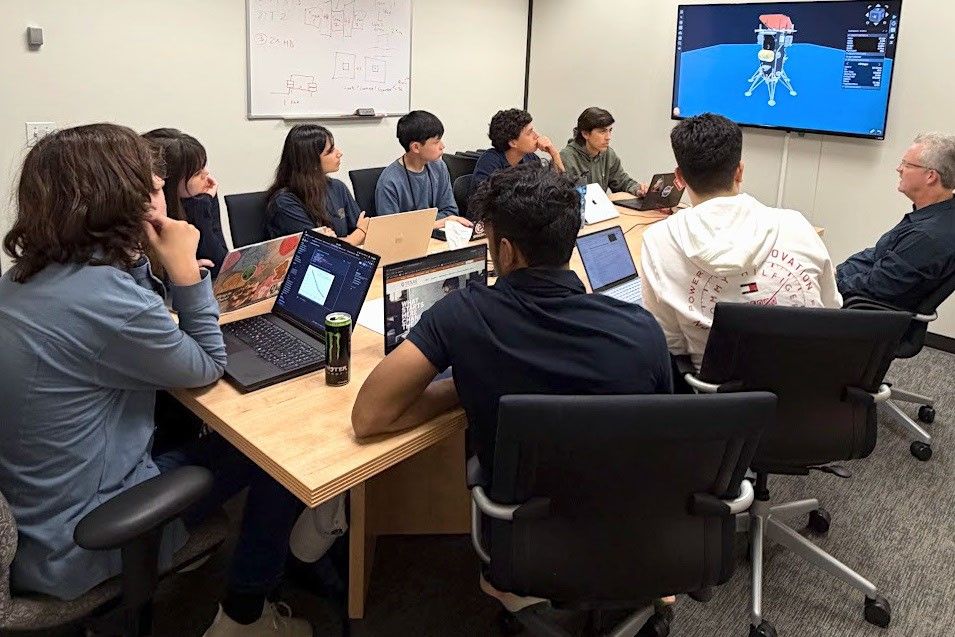
NASA's Science Activation program highlights a group of high school interns tackling real-world challenges in lunar exploration. The Matrix Team, comprised of four students, developed an interactive dashboard for the IM-3 mission. This tool allows users to adjust engine, spacecraft, and orbital parameters to study the impact on propellant margins and landing zone availability.
The SEES Internship Program at the University of Texas Center for Space Research places students on mission-focused research teams led by experts from NASA, academia, and industry. During summer 2026, the MATRIX team concentrated on refining a method for measuring propellant mass in microgravity, a crucial factor for NASA's Artemis missions.
Led by Dr. Kevin Crosby, the team utilized the Modal Propellant Gauging (MPG) approach, which gauges fuel mass in tanks by analyzing their acoustic response. This method has proven effective in spaceflight experiments and will be demonstrated on the Intuitive Machines IM-3 mission. Scheduled to land on the Moon in 2027, the IM-3 lander, named Trinity, will provide the interns with valuable experience in a technology set to support lunar surface operations.
By relying solely on publicly available data, including mission details from Intuitive Machines and trajectory records from NASA's Jet Propulsion Laboratory, the MATRIX team reconstructed the IM-3 mission. They used computational fluid dynamics and Monte Carlo simulations to model fluid behavior and predict propellant state possibilities.
The team discovered that MPG can provide reliable readings during crucial mission phases, including Lunar Orbit Insertion and Powered Descent. The students presented their research, "Computational Models to Estimate Modal Propellant Gauging (MPG) Windows on the Intuitive Machines IM-3 Mission," at various conferences, impressing NASA engineers with their advanced understanding and creative work.
The SEES program, now in its decade, offers high school students hands-on experience with data, tools, and analytical methods used in the aerospace industry, preparing them for future roles in space exploration.
Written by urgent.news from NASA's reporting — not their text. Machine-written — may contain errors; check the original before relying on it.
This story
This is one outlet's version. Read the fullest account.
- NASA SEES Interns Tackle Real-World Challenges in Lunar Exploration science.nasa.gov


