Build a Hidden Lock With a Magnetic Imager
Like many a nerd, I have a certain fascination with locks. This originates in reading the memoir Surely You’re Joking, Mr. Feynman as a teenager, in which Richard Feynman recounts picking locks and cracking combinations while at his day job working on the Manhattan Project at Los Alamos. I currently have a couple of locksport pick sets and training locks that I purchased at hacker conferences…
In a recent piece from IEEE Spectrum, James Provost details his creation of a hidden lock using a magnetic imager. Drawing inspiration from his fascination with locks and his experience with lockpicking, Provost wanted to build a lock that concealed its existence. This led him to explore magnetic locks, which are released when a magnet is slid against an innocuous portion of a door or box.
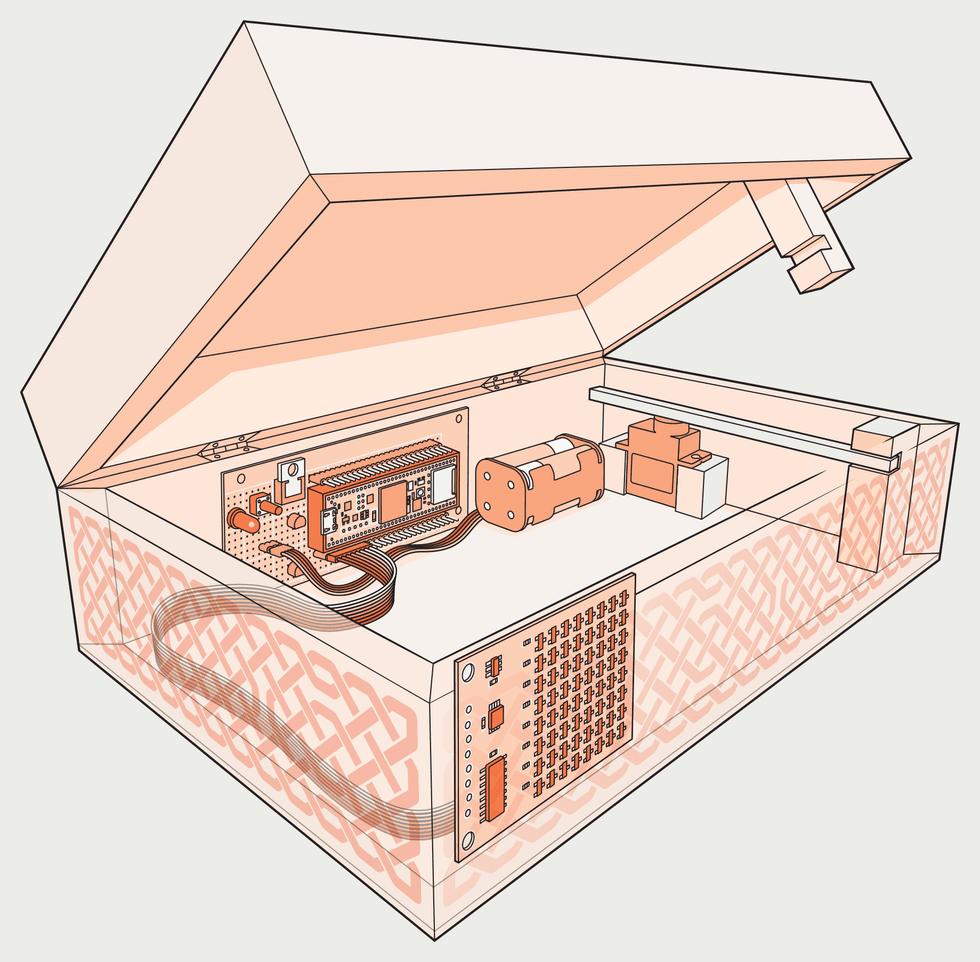
However, the challenge with magnetic locks is that any strong magnet can open them once the location is known. To overcome this, Provost turned to an RFID reader and then discovered SparkFun's magnetic imaging tile—an inexpensive $100 board featuring an 8-by-8 grid of Hall-effect sensors. These sensors can detect both the magnitude and polarity of magnetic fields and communicate with a microcontroller.
Provost chose a Teensy 4.1 microcontroller for its extensive input/output, strong processor, RAM, and onboard SD card, all in a slim package at a low price. He managed to wire the Teensy to the magnetic-imaging tile, with a minor complication due to a silk-screen error on the board. To address potential concerns about paranoia, he suggested shielding the lock behind a copper sheet, which would block any RFID signals and other electromagnetic fields.
Provost created a gesture-recognition system using vibe coding, with two support libraries for recording and monitoring gestures. He built a wooden craft box with a hidden lock mechanism, incorporating the magnetic imaging tile into the design. While the tile's sensing area is small, Provost managed to camouflage it using a Celtic knotwork pattern, creating a repeatable gesture within the sensor area.
Written by urgent.news from IEEE Spectrum's reporting — not their text. Machine-written — may contain errors; check the original before relying on it.