Your Client Is Borrowing From You: The Cash Exposure Math of a Freelance Project
The same $12,000 freelance project can put $12,000 or $3,000 of your work at risk. How payment terms set your cash exposure, week by week.
Freelancers often view payment terms solely through the lens of trust. However, a more insightful perspective is that each hour of work completed before receiving payment represents money loaned to the client, interest-free and without collateral. The amount owed at any given time is the exposure, calculated as the value of work delivered minus the cash received.
This figure increases as work progresses, decreases when payments are made, and represents the maximum amount you would lose if the client disappears suddenly. Payment terms significantly influence this exposure, with the difference between a well-structured contract and a poorly designed one being substantial rather than marginal.
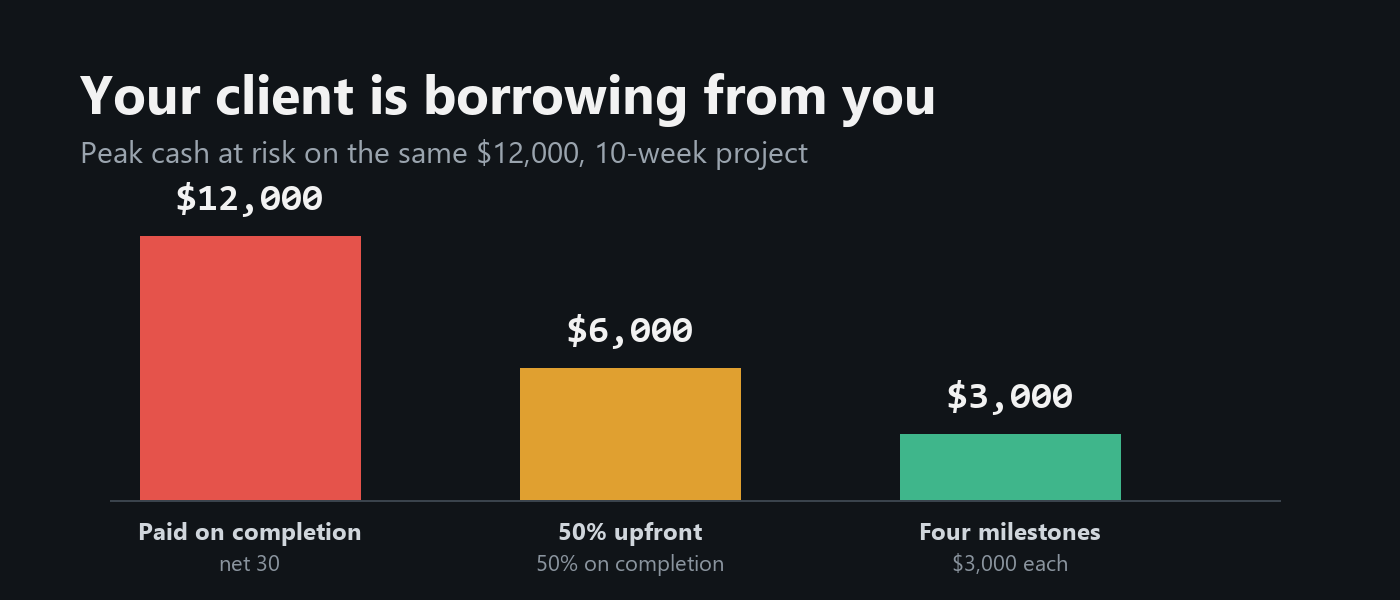
Consider a $12,000 project spanning ten weeks, with work evenly distributed. Exposure at the end of each week can be determined by subtracting the cash received from the work delivered. A negative exposure indicates the client has paid ahead of the work completion, while a positive exposure signifies a loan to the client. For Structure A, which involves payment upon project completion with a 30-day grace period, the peak exposure reaches $12,000, held for four weeks.
During the fourteen-week duration, the freelancer finances the client's project, with the entire fee outstanding for the last four weeks. If the client fails to respond in week 12, three months of work remains unpaid. Structure B, the customary 50/50 split where 50% is paid upfront and the remaining 50% at project completion, reduces peak exposure to $6,000.
This structure ensures that the first five weeks of the project bear the client's risk, while the subsequent nine weeks expose the freelancer to the full amount. The final payment structure, Structure C, divides the $12,000 into four equal installments of $3,000, with payments due seven days apart, culminating in the final payment at project completion.
This approach reduces the peak exposure to $3,000 and concludes the project two weeks ahead of Structure A. The key principle underlying these structures is that the peak exposure, or the largest payment pending at any point, dictates the maximum amount at risk. By strategically distributing payments, freelancers can effectively manage their exposure, turning payment negotiations from trust-based discussions to mathematical calculations.
Late payments can be more detrimental than accepting lower rates. For instance, a 30-day delay in payment for Structure A amplifies the exposure period, costing approximately $220 in additional interest when compared to Structure C, where the exposure is limited to $3,000. Milestone-based payments not only cap exposure but also mitigate the impact of late payments, as they provide concrete checkpoints for verification and ensure that work pauses until payments are received, thus maintaining the structure's protective integrity.
To design effective payment structures, freelancers should first quantify the project fee and its duration, determining the weekly value of work. Subsequently, they should map out the payment schedule, identifying the week with the highest exposure. If the exposure exceeds their acceptable risk level, adjusting the payment structure is the pragmatic solution.
Rewritten by urgent.news; may contain errors — check the original.