Why Chinese pundits say France’s riots could reshape European politics
The social unrest roiling France is being closely watched for a possible spillover effect beyond the country’s borders that could reshape European politics, Chinese analysts said. The crisis is a major stress test for French politicians as they navigate deep-seated economic and societal tensions in the run-up to the country’s presidential election in April next year, according to the analysts. A…
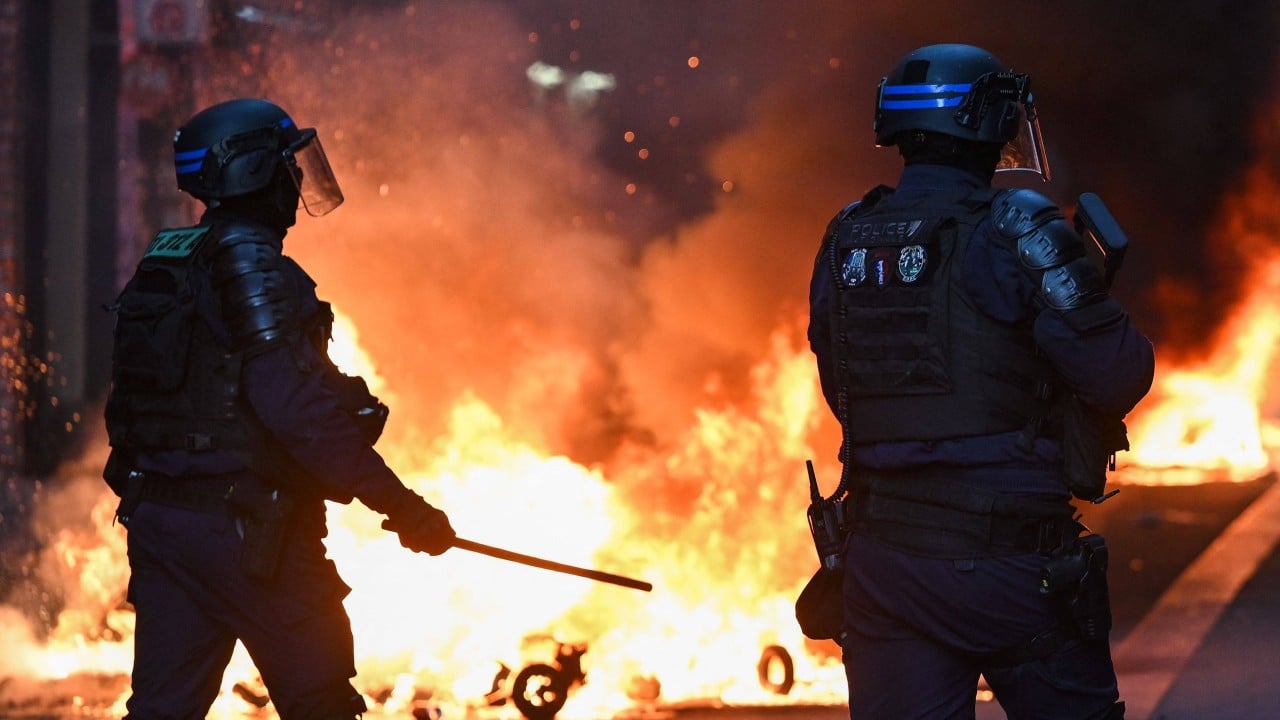
Chinese experts are closely monitoring France's recent social unrest, anticipating its potential impact on European politics. The crisis is seen as a significant test for French politicians leading up to the presidential election next April. Analysts are curious whether the riots will quickly dissipate or spiral into prolonged instability, with political parties across the spectrum attempting to capitalize on the unrest for electoral gains.
Cui Hongjian, director of European Union studies at Beijing Foreign Studies University, pointed out that the growing tension between ordinary citizens and the government has reached a critical point. Even a small incident can trigger widespread fury, according to Cui. The student protests over poor school conditions have evolved into nationwide riots after peaceful demonstrations turned violent, with looting and arson.
Over 550,000 people have protested, resulting in more than 2,000 arrests and at least two reported deaths.
President Emmanuel Macron is under intense political, economic, and social pressure as his second term approaches its end. He has called for a meeting of various stakeholders, including students, educators, parliamentarians, labor organizations, and business representatives, to develop concrete proposals to address the crisis. Demonstrations are scheduled to resume this Saturday, prompting French Prime Minister Sebastien Lecornu to beef up security measures and impose new curfews if necessary.
French policymakers are grappling with a public debt nearing 120% of GDP and a projected budget deficit of 5.4% in 2026. The crisis has squeezed domestic budgets for social programs, forcing the government to limit spending, freeze wages, and provide below-inflation increases for education. Song Luzheng, a France-based researcher at Fudan University's China Institute, sees the protests as a manifestation of France and Europe's declining competitiveness due to high costs, low efficiency, and weak innovation.
He attributes the issue to the erosion of Europe's middle class caused by globalization, financialization, and automation.
The unrest has unfolded as France prepares for its presidential election, with China featuring in debates over economic sovereignty, market protection, and geopolitical rivalry. The French political landscape is divided between Marine Le Pen's far-right National Rally and Jean-Luc Melenchon's hard-left coalition, with polling indicating National Rally holds a strong position.
Le Pen has portrayed the unrest as a "crisis of trust and authority" under Macron, emphasizing security and public order. In contrast, Melenchon and his party have criticized the government's crisis management and expressed solid support for the protesters.
Both Cui and Song assert that French political parties are exploiting public anger to advance their electoral ambitions ahead of the upcoming presidential vote. Far-right parties and figures have positioned themselves as champions of popular discontent, capitalizing on issues such as immigration and fiscal discipline to heighten confrontation between the public and mainstream parties.
Cui and Song argue that economic development and social justice must be properly coordinated, given the challenges faced by many countries worldwide. They warn that the situation in France could have far-reaching implications beyond its borders, particularly if far-right forces were to gain power in France and Germany, the EU's twin pillars.
Written by urgent.news from Reuters Business via SCMP's reporting — not their text. Machine-written — may contain errors; check the original before relying on it.