Financing the AI Physical Capital Buildout
The amounts of money being spent on the hardware and buildings behind the new AI boom may turn out to be enormously large by historical standards. How is it being financed? Stijn Van Nieuwerburgh tells the story in “Financing the AI Buildout” (Brookings Papers on Economic Activity, Fall 2026, conference draft version). As he points … Continue reading Financing the AI Physical Capital Buildout The…
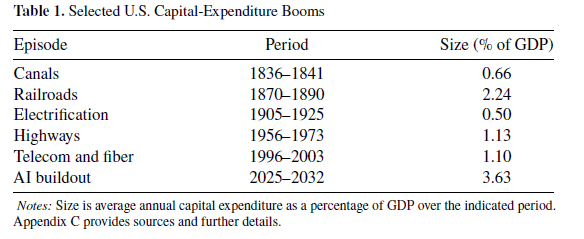
The cost of the AI buildout is anticipated to be exceptionally high by historical standards, with firms such as Oracle, Microsoft, Amazon, Meta, and Alphabet investing billions of dollars in data centers, semiconductor plants, increased energy production, and more. The financing for this investment is coming from a mix of equity and debt structures, with specialized data center developers, REITs, infrastructure funds, private equity investors, bank loans, bonds, and private credit funds providing the necessary capital.
Private credit funds, in particular, have emerged as a significant source of financing, with outstanding loan amounts totaling $2.5 trillion as of 2025. These funds make loans based on expected cash flows and intangible assets, rather than requiring physical collateral like traditional bank loans. This structure reduces the risk of systemic contagion should a private credit fund's loan portfolio go sour, as the investor would suffer losses but would not cause a broader economic impact.
Compared to previous technology booms, such as the internet era, the AI buildout presents a unique challenge in terms of the scale of investment required and the associated risks. While some AI software companies have experienced rapid growth and high stock market valuations, there is uncertainty about how the actual revenue generated from the AI technologies will materialize. Investors are understandably concerned about the potential for losses if the AI boom does not generate revenue as quickly as anticipated.
Written by urgent.news from Conversable Economist's reporting — not their text. Machine-written — may contain errors; check the original before relying on it.