Nvidia's Huang hails Europe's AI potential, flanked by robot ducks
In a demonstration of Europe's AI creativity, Huang shared the stage with tiny duck-shaped, AI-trained robots developed by French startup Pollen Robotics in collaboration with Hugging Face, asking them to perform somersaults.
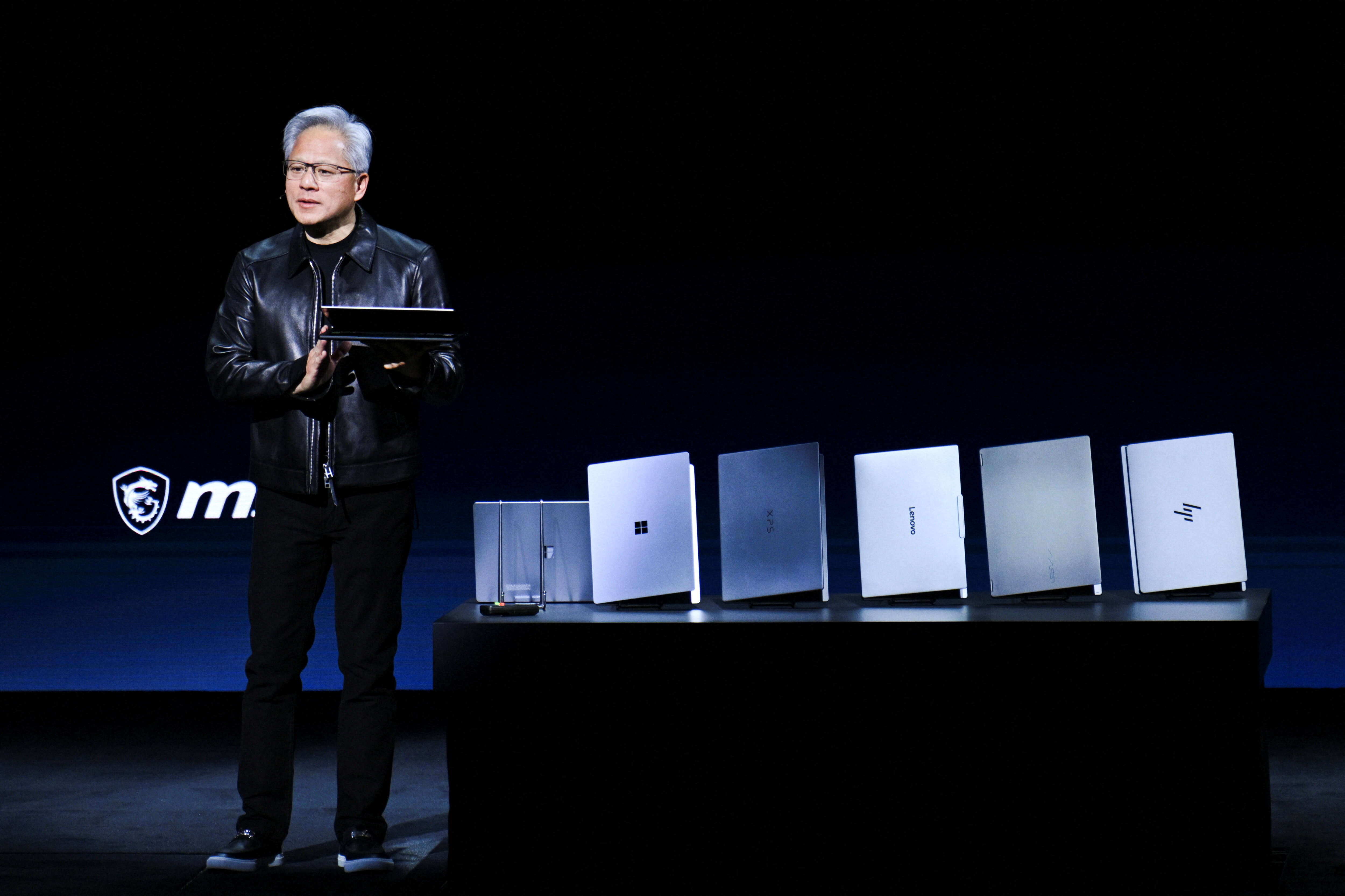
Nvidia's CEO, Jensen Huang, expressed confidence in Europe's engineering prowess and its potential in the realm of physical AI and robotics during a recent visit to Berlin. At the company's GTC conference, Huang unveiled expanded partnerships with European manufacturers and startups, emphasizing that every European company would eventually become an AI entity.
Huang praised Europe's dedication to mechatronics, electronics, and mechanical systems, noting that no region matches the precision and craftsmanship of the European region. To illustrate Europe's AI capabilities, Huang showcased tiny duck-shaped robots developed by French startup Pollen Robotics in collaboration with Hugging Face. These robots performed somersaults on stage at Huang's invitation.
Nvidia has already committed nearly $10 billion to Europe's technology ecosystem, aiming to secure a significant commercial interest in the region's growth. This commitment includes establishing partnerships such as Agile Robots, a German company that plans to produce 1,000 to 2,000 petite humanoids next year in collaboration with Nvidia. Production is expected to begin late this year.
Huang underscored the importance of Europe playing a central role in the AI economy, stating that the region should not merely consume AI but also produce it. He argued that Europe could achieve this by fostering AI development and not just relying on external sources like Nvidia, Anthropic, or OpenAI.
During the conference, Nvidia also presented a new DSX POD design for factory-built data center modules using its Vera Rubin platform. These modules can be deployed in as little as two weeks, a significant improvement from the six-month timeframe previously required. However, the demonstration was not without setbacks, as three of the four Microducks failed to follow Huang's instructions to take a nap, while the fourth required additional persuasion.
Additionally, one duck appeared distracted and faced the wrong way as Huang concluded his speech, prompting him to sternly remind the robot to pay attention and stay focused.
Written by urgent.news from Economic Times Tech's reporting — not their text. Machine-written — may contain errors; check the original before relying on it.
This story
This is one outlet's version. Read the fullest account.
- Nvidia CEO Huang pitches Europe to adopt AI in all industries businesstimes.com.sg
- GTC Berlin: Jensen Huang pushes Europe on AI adoption, saying "for Europe to benefit from AI ... you need all the end markets, the end industries to adopt AI" (Bloomberg) bloomberg.com
- Jensen Huang is urging Europe's industries to become AI companies at GTC Berlin qz.com